How to Organize Under-Sink Space in a Small Apartment
Under-sink storage is one of the most frustrating parts of a small apartment. It looks like it should be useful, but in reality it is often awkward, dark, easy to overfill, and shaped around plumbing that cuts into the most usable space. In kitchens and bathrooms alike, under-sink cabinets quickly become the place where random items pile up: cleaners, trash bags, sponges, extra soap, paper goods, toiletries, and backup supplies that never seem to stay organized for long.
In a small apartment, that problem gets bigger because every storage zone matters more. When the cabinet under the sink is cluttered, the mess usually spills outward. Kitchen counters start collecting dish supplies. Bathroom counters fill with daily-use products. Cabinets become difficult to close, things get pushed to the back and forgotten, and you end up buying duplicates because you cannot see what you already have.
The good news is that under-sink storage can work extremely well when it is organized around the actual constraints of the space. Instead of forcing the cabinet to function like a normal rectangular shelf, the goal is to build a system that works around the pipes, uses vertical room wisely, and makes the items you use most easy to grab.
This is why under-sink organization should be treated as part of your larger small-space strategy, especially when paired with Best Under-Sink Storage Solutions for Small Spaces, Best Cabinet Storage Solutions for Small Apartments, and How to Maximize Storage in a Small Apartment. When this area is set up correctly, it can help reduce clutter across the rest of the apartment and make daily routines noticeably easier.
Why under-sink cabinets become cluttered so quickly
Under-sink cabinets are difficult to organize because they combine several storage problems at once. They are low to the ground, partially blocked by plumbing, often deeper than they look, and easy to treat as hidden dumping zones. Since the door closes, it is tempting to keep shoving more inside without any real system.
That is especially true in small apartments where under-sink storage is expected to do a lot of work. In the kitchen, it may be storing dish soap, sponges, gloves, trash bags, dishwasher pods, cleaners, scrub brushes, and backup supplies. In the bathroom, it may be handling toiletries, toilet paper, extra soap, cleaning products, grooming tools, and personal care items. Without clear categories, everything competes for the same small footprint.
Another problem is visibility. Under-sink cabinets often turn into stacked layers of products where only the front row is visible. Items in the back become forgotten, duplicates accumulate, and daily-use products get buried under things you barely need. That is why this space often feels “too small” even when the real issue is poor layout rather than total capacity.
In many apartments, the solution is not to cram in more. The solution is to make better decisions about what belongs there, what needs to be easier to reach, and what should be stored elsewhere.
Start by emptying the cabinet completely
Before you choose bins, risers, baskets, or drawers, take everything out. This step matters more than people think. You cannot create a useful under-sink system while organizing around expired products, duplicates, or items that do not really belong there.
As you empty the space, sort everything into categories such as:
- daily-use cleaning supplies
- dishwashing items
- bathroom toiletries
- backup supplies
- paper products
- tools or miscellaneous items
- products that should be thrown away
- products that belong in another room
This gives you a much clearer picture of what the cabinet is actually being asked to store. Many people discover that under-sink clutter comes less from lack of storage and more from lack of boundaries. Once you separate daily-use items from backup stock and random overflow, the cabinet usually starts looking more manageable right away.
This is also a great point to apply the same editing mindset from How to Declutter a Small Apartment Fast. If something is expired, rarely used, duplicated for no reason, or better suited to another area, do not automatically put it back.
Measure around the plumbing before buying organizers
Under-sink spaces are rarely clean rectangles. Pipes, disposal units, water shut-off valves, and uneven cabinet walls all affect what can realistically fit. That means measurements are essential.
Take note of:
- cabinet width
- cabinet depth
- total interior height
- height below the pipes
- open space on either side of the plumbing
- door clearance
- any fixed obstacles inside the cabinet
These measurements help prevent one of the most common mistakes: buying organizers that technically fit the cabinet but do not fit around the plumbing. A storage bin may look perfect online, but if it blocks the pipe curve or prevents the door from closing, it becomes wasted space.
It also helps to think in zones rather than one big empty cabinet. Most under-sink spaces have a center obstruction with usable areas on the left, right, and sometimes the back or upper section. Once you start seeing the cabinet in those smaller zones, it becomes much easier to assign each area a purpose.
Decide what should actually stay under the sink
Just because a cabinet exists under the sink does not mean every related item belongs there. In a small apartment, the most effective storage systems work because they are selective.
Under the sink is usually best for:
- everyday cleaning products
- sponges and scrubbers
- dishwashing supplies
- daily-use bathroom items
- trash bags
- a small amount of backup stock
Under the sink is often not the best place for:
- bulky paper products
- large backup quantities
- rarely used supplies
- heavy tools
- seasonal items
- items sensitive to moisture
For example, if you are using the under-sink cabinet to store large backup packages of cleaning refills, excess toiletries, or extra linens, you may be forcing too much into a space that should stay focused on daily function. Those overflow items may do better in Best Bathroom Storage Solutions for Small Apartments, Best Storage Solutions for Small Apartments, or Best Storage Shelves for Small Spaces.
The more selective you are, the easier the cabinet is to maintain.
Use vertical space without blocking access
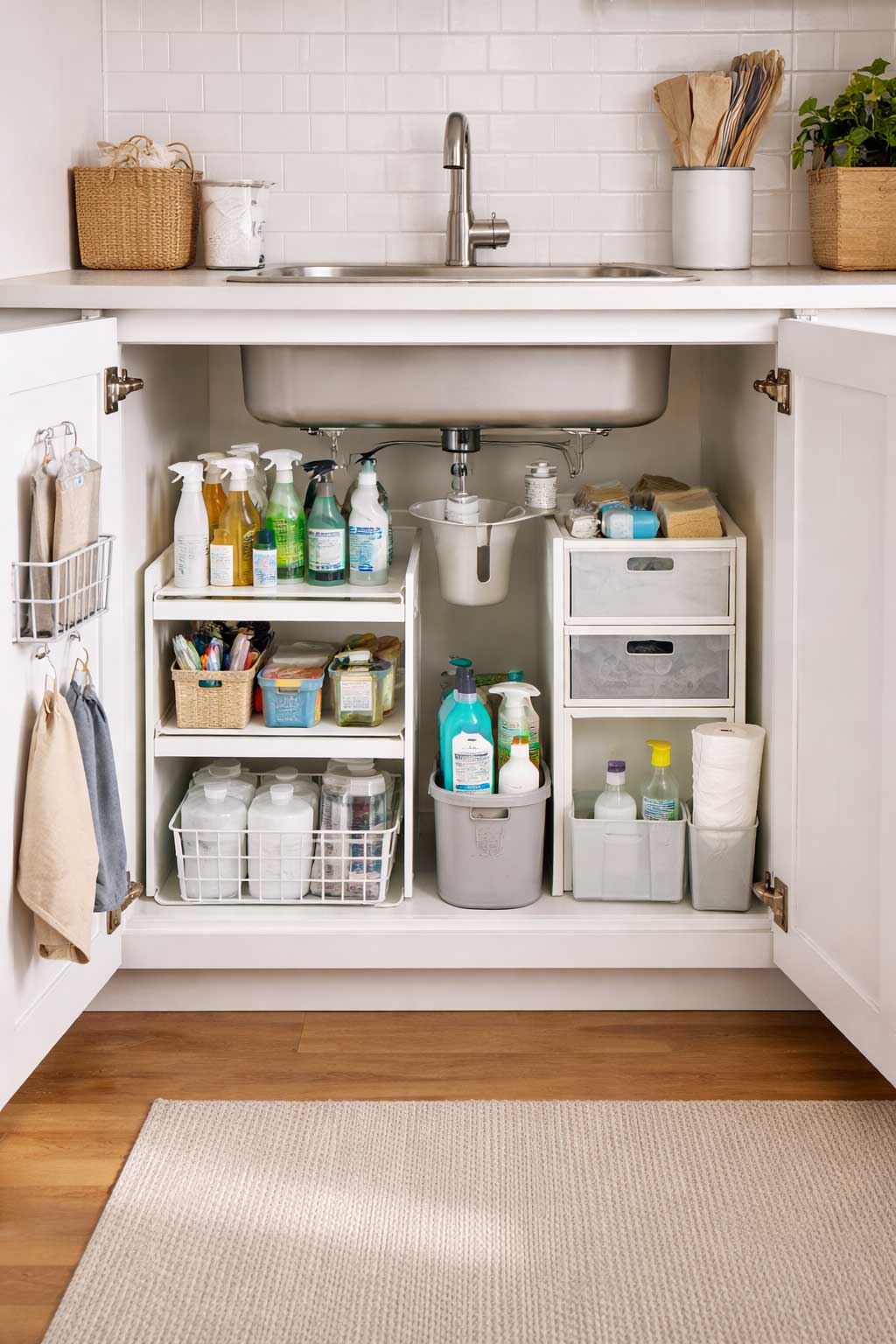
One of the best ways to improve under-sink storage is to use the height inside the cabinet more intentionally. A lot of apartments waste vertical room because everything is stored directly on the cabinet floor, even though the cabinet has enough height for stacked layers.
That does not mean you should stack products blindly. It means you should look for ways to add structure, such as:
- shelf risers
- stackable bins
- narrow drawer units
- tiered organizers
- under-shelf baskets
- expandable shelving around pipes
Vertical storage works best when it still preserves visibility and reach. A second level is only useful if you can still get to what is underneath without unpacking the entire cabinet every time.
This same principle shows up across many small-space problem areas, which is why How to Use Vertical Space in a Small Apartment is such a useful supporting article for your site. Under-sink organization is really just one version of the bigger small-apartment challenge: making the most of space you already have instead of relying on more square footage.
Create clear zones inside the cabinet
The easiest under-sink cabinets to maintain are the ones where each category has a defined place. Once the cabinet is divided into zones, it becomes much easier to reset after cleaning, restocking, or daily use.
A simple zone breakdown might look like this:
Daily-use zone
This should hold the items you reach for most often. In a kitchen, that might be dish soap, sponges, dishwasher tablets, and surface spray. In a bathroom, it might be hand soap refills, toilet cleaner, wipes, and frequently used toiletries.
These items should stay toward the front and at the easiest height to access.
Backup supply zone
This can hold a small reserve of essentials such as extra trash bags, an extra bottle of cleaner, or one backup hand soap. The key word is small. Under-sink cabinets should not become wholesale storage.
Tool or accessory zone
This can include scrub brushes, gloves, small cleaning tools, or extra organizers used with your sink area.
Hard-to-store side zones
The narrow spaces beside plumbing are often ideal for slim bins, hooks, or upright bottles. These are valuable areas that are often ignored.
Once zones are assigned, the cabinet becomes easier to read at a glance. That alone reduces clutter because you are no longer asking the whole cabinet to do everything at once.
Use containers that fit the cabinet, not generic bins
A lot of under-sink storage frustration comes from trying to use random leftover bins that do not match the cabinet’s shape. Under-sink organization works best when the containers are chosen around the actual layout of the space.
Look for containers that are:
- narrow enough to fit around plumbing
- shallow enough to keep items visible
- easy to lift out or slide forward
- sturdy enough for repeated use
- simple enough not to waste space with thick walls or oversized rims
Deep bins often create hidden clutter because items disappear into the back. Shallow bins, handled caddies, or open-top organizers usually work better for frequently used products. Clear containers can also be helpful if you want faster visibility, though solid bins may look tidier depending on your preference.
This is one reason Best Cabinet Storage Solutions for Small Apartments and Best Under-Sink Storage Solutions for Small Spaces are important money-page companions to this article. The products matter, but only when they are matched to how the cabinet actually functions.
Kitchen under-sink organization works differently than bathroom under-sink organization
Not all under-sink cabinets should be organized the same way. The best setup depends on what room the sink is in and what you need that cabinet to support.
Kitchen under-sink organization priorities
Kitchen sink cabinets usually need to support cleaning and utility functions. Priorities often include:
- dish soap
- dishwasher pods
- sponges
- scrub brushes
- gloves
- trash bags
- all-purpose cleaner
- small sink tools
In most kitchens, the cabinet works best when daily cleaning items stay front and center and backup stock is limited. If you are also struggling with overflow around the rest of the kitchen, it helps to pair this area with How to Organize a Small Kitchen with Limited Cabinet Space and Best Kitchen Storage Solutions for Small Apartments.
Bathroom under-sink organization priorities
Bathroom sink cabinets often need a different balance. They may hold personal care items, toilet paper, extra soap, basic cleaners, and daily-use grooming supplies. Moisture and product variety make containment especially important here.
If your bathroom has very little cabinet space overall, you may need to combine under-sink organization with nearby shelving, wall-mounted storage, or counter organization. That is where Best Bathroom Storage Solutions for Small Apartments and How to Organize a Small Apartment Bedroom can support the broader flow of personal care and overflow storage in the apartment.
Keep the most-used items at the front
This sounds simple, but it is one of the biggest differences between a cabinet that works and one that constantly falls apart.
The front of the cabinet should be reserved for what you use regularly. The back should be for items you reach for less often. Too many people do the opposite by pushing essentials behind larger backup items, which makes the cabinet frustrating to use every day.
A good rule is this:
- front = daily-use items
- middle = weekly-use items
- back = occasional-use items
- upper or side zones = small extras and backup supplies
When products are arranged by frequency of use, the cabinet becomes much easier to maintain because you are not disturbing the entire system every time you need one thing.
Do not let backup supplies take over the space
In small apartments, one of the fastest ways to ruin a storage system is to let backup inventory take control of prime storage areas. Under-sink cabinets are especially vulnerable to this because they feel hidden and convenient.
It is fine to keep a limited backup quantity of essentials, but this cabinet should not become the place where every extra bottle, refill, and paper good gets stuffed. Large back-stock belongs in a different zone of the apartment whenever possible.
For example, extra household supplies may do better in Best Storage Solutions for Small Apartments with No Closet, Best Wall-Mounted Storage Solutions for Small Apartments, or Best Over-the-Door Storage Solutions for Small Apartments if your apartment needs overflow help elsewhere.
Think of under-sink storage as a working cabinet, not a warehouse.
Make the cabinet easy to clean and reset
Any storage system that is too complicated will eventually fail. Under-sink organization works best when it is easy to wipe down, easy to understand, and easy to reset after regular use.
That means keeping the system simple enough that:
- spills can be cleaned quickly
- bins can be lifted out easily
- categories are obvious
- nothing needs to be completely unpacked to reach one product
- the cabinet can be tidied in a minute or two
This matters because under-sink cabinets deal with leaks, drips, residue, and frequent handling. If the setup is too delicate or overly packed, maintenance becomes annoying and clutter returns fast.
Simple systems are usually more sustainable than elaborate ones.
Common under-sink organization mistakes to avoid
Many under-sink cabinets stay messy because of a few recurring mistakes.
Treating the cabinet like one big open box
Without zones or containers, products drift and pile up quickly.
Using organizers that block plumbing
Even attractive storage pieces become useless when they fight the layout of the cabinet.
Storing too many categories together
Mixing cleaners, toiletries, tools, and overflow stock in one shared pile creates confusion and wasted space.
Keeping things you rarely use
Under-sink areas should support function, not long-term clutter.
Ignoring nearby storage opportunities
Sometimes the best under-sink solution is partly under the sink and partly elsewhere. If your cabinet is too small, combine it with Best Storage Solutions for Small Bathrooms Without Cabinets or How to Create Storage in a Small Apartment with No Closet rather than trying to force everything into one tight space.
A simple under-sink organization plan for small apartments
If you want a straightforward system, this is the easiest way to approach it:
Step 1: Empty everything out
Remove all products and wipe the cabinet clean.
Step 2: Sort by category
Separate daily-use items, backup stock, tools, and anything that belongs somewhere else.
Step 3: Measure the usable zones
Identify what space exists beside, behind, and above the plumbing.
Step 4: Limit what goes back in
Only return the items that truly belong there.
Step 5: Add simple structure
Use bins, caddies, risers, or narrow drawers that fit the cabinet shape.
Step 6: Place daily items in front
Make essentials the easiest things to reach.
Step 7: Reassess after one week
Notice what still piles up, what is hard to reach, and what categories need adjustment.
This kind of system works because it is practical. It does not rely on perfection. It relies on access, visibility, and restraint.
The best under-sink setup is the one that supports daily life
The right under-sink organization system does not need to look like a showroom. It just needs to make everyday life easier. In a small apartment, that means the cabinet should be easy to open, easy to read, easy to clean, and easy to maintain without constant rearranging.
When that area is working well, the difference spreads into the rest of the apartment. Counters stay clearer. Cleaning supplies stay accessible. You stop buying duplicates. You waste less time hunting for things at the back of the cabinet. And the space feels more intentional instead of chaotic.
That is the real goal. Not perfection. Not over-designed storage for the sake of aesthetics. Just a cabinet that fits your routine and helps the apartment function better as a whole.