How to Create a Pantry Zone in a Small Apartment Kitchen
Creating a pantry zone in a small apartment kitchen can make the whole space feel easier to use, even if you do not have a real pantry. In many apartments, dry goods, canned food, snacks, baking supplies, and backup groceries end up scattered across different cabinets, piled onto counters, or tucked into random corners with no real structure. The problem is not just a lack of space. It is a lack of one defined area where pantry-style food storage actually lives.
The good news is that a pantry zone does not need a walk-in pantry or a huge cabinet to work well. In most small apartments, the best setup comes from choosing one primary food-storage area, grouping pantry items by category, and using shelves, bins, risers, or carts to make that zone function like a real pantry. With the right approach, even a compact kitchen can have a pantry system that feels organized and easy to maintain.
For product ideas built for this exact issue, explore our Best Storage Solutions for Small Kitchens Without Pantries guide.
If you want broader pantry-style organization ideas, check out Best Pantry Storage Solutions for Small Apartments.
If your current kitchen feels scattered with food overflow, browse How to Organize Food Storage in a Small Apartment With No Pantry.
This guide is part of our Small Kitchen & Dining Solutions collection.
Quick Answer
If you want to create a pantry zone in a small apartment kitchen, the best approach is to assign one clearly defined storage area for pantry foods and organize it by category instead of storing food wherever it happens to fit. In most kitchens, that means turning part of a cabinet, a shelf, a rolling cart, or a nearby storage piece into a pantry-style zone for dry goods, canned items, snacks, and backup groceries.
A good pantry-zone setup usually works best when it includes:
- one clearly defined food-storage area
- grouped pantry categories instead of random shelf placement
- vertical storage that makes the zone easier to use
- limited countertop overflow
- a setup that makes pantry items easy to see and restock
Why Small Apartment Kitchens Need a Defined Pantry Zone
A small kitchen without a pantry usually does not just have a storage problem. It has a location problem. Food exists in the kitchen, but it does not have one clear home. Crackers may be in one cabinet, rice in another, canned soup somewhere else, and extra snacks on the counter because no other spot feels obvious.
That kind of scattered setup makes the kitchen feel more cluttered than it really is. It also makes grocery restocking harder. You buy duplicate items because you cannot see what you already have. Daily-use foods stay out on the counter because they are annoying to reach. Cabinets start feeling overstuffed because pantry foods are mixed with dishes, cookware, and kitchen tools.
That is why a defined pantry zone matters so much. Even in a small apartment, one clearly chosen food-storage area makes the whole kitchen work better. The goal is not to invent more square footage. It is to stop pantry items from living everywhere at once.
Start by Choosing Where the Pantry Zone Should Live
The best pantry zone is usually the one that fits your kitchen most naturally, not the one that sounds ideal in theory. In some apartments, that may be one upper cabinet. In others, it may be one tall awkward cabinet, one lower cabinet with risers, a rolling cart, or even a nearby dining-area cabinet if the kitchen itself is too tight.
The most important thing is choosing one primary home for pantry categories. If the kitchen has one cabinet with decent height and easy access, that may be the best choice. If cabinet storage is extremely limited but there is room for a slim rolling cart, that may work better. If you live in a studio and need food storage to stay visually controlled, a closed nearby cabinet may be the stronger solution.
A pantry zone works best when it feels intentional. Once you decide where it lives, the rest of the food-storage system gets much easier to build around that choice.
Group Pantry Items by Category Instead of By Whatever Fits
A pantry zone stops working the moment food goes back to being stored by random open space. Category grouping is what makes the zone actually function like a pantry instead of just another cabinet.
Dry goods should have a section. Canned food should have a section. Snacks should have a section. Baking supplies, breakfast foods, and backup groceries should each have rough homes too. These sections do not need to be perfectly labeled or rigid, but they should be clear enough that you know where something belongs and where to look for it.
This matters because different foods behave differently. Snack pouches scatter. Cans stack poorly. Flour and rice bags slump and spill. When everything is mixed together loosely, the pantry zone becomes harder to shop from and harder to maintain. Grouping by category turns the pantry area into a working system instead of a crowded holding space.
Choose the Best Storage Type to Make the Pantry Zone Work Better
The best organizers depend on what kinds of food you are storing and where the pantry zone lives.
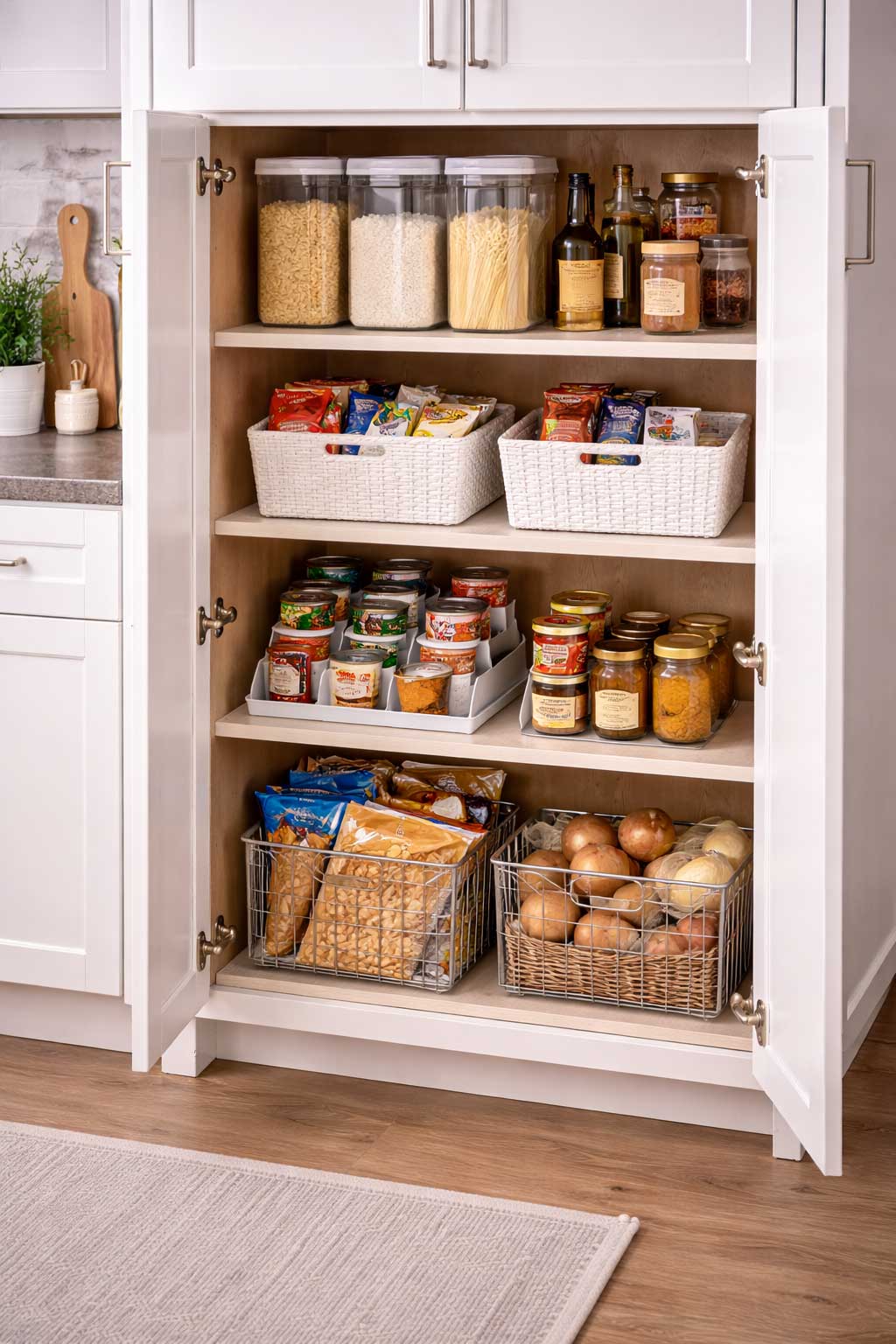
Stackable containers work especially well for dry goods like pasta, cereal, flour, rice, sugar, oats, and grains. They reduce wasted space and make shelves easier to read. They also help when original packaging does not stack well.
Baskets or bins are strong for snacks, packets, bars, baking extras, and smaller grocery categories that otherwise slide around. These are especially useful when one category includes lots of small packages.
Can organizers help when canned foods keep disappearing into the back of a shelf or turning into unstable towers. They make it easier to see what you actually have and use the space more cleanly.
Shelf risers are one of the best tools for cabinet pantry zones because they help use vertical height without forcing foods into messy piles. They are especially helpful for canned items, jars, and shorter pantry staples.
Rolling carts work well when the kitchen needs overflow pantry storage outside the main cabinet footprint. A cart can hold snacks, dry goods, canned foods, or breakfast items in one clearly defined place.
Nearby freestanding cabinets or shelves make sense when the kitchen itself cannot realistically hold all pantry foods. In many small apartments, a pantry zone just outside the kitchen works better than pretending everything must fit inside the kitchen cabinets.
The key is matching the organizer to the category and the storage location instead of buying bins first and trying to force a system around them later.
Best Pantry Zone Setups for Common Small Apartment Kitchen Layouts
If your kitchen is tiny and one cabinet has to do most of the pantry work, the best setup usually comes from tight category editing. In that kind of layout, every shelf needs a job. Dry goods may live on one shelf, snacks on another, and canned goods below, with backstock stored elsewhere.
If your kitchen has one tall awkward cabinet, that cabinet often makes the best pantry zone. With shelf risers, bins, and some category separation, an awkward cabinet can become far more useful than a wide shallow cabinet where everything disappears behind itself.
If your kitchen has no pantry but does have room for a rolling cart, the cart can become the pantry zone or at least a major part of it. This works especially well when the cart is used for overflow categories that do not fit comfortably in the main kitchen cabinets.
If you live in a studio apartment where the pantry zone is visible from the living area, visual control matters more. Matching containers, grouped baskets, and restrained countertop storage usually work better in that type of layout than leaving branded food packages and random grocery overflow in view.
Keep Everyday Pantry Items Easy to Reach Without Letting Them Spill Onto the Counter
Counter clutter usually happens when the foods you use most are too inconvenient to access inside the pantry zone. Bread, cereal, coffee supplies, bars, chips, oats, crackers, and breakfast foods end up staying out because it feels easier than putting them away.
A better pantry zone makes everyday categories easy to grab without letting them fully live on the counter. This may mean giving breakfast foods one shelf at eye level, keeping snacks in one basket near the front, or using one section for coffee, tea, and frequent staples. When daily-use items are easier to reach, the kitchen naturally stays cleaner.
This does not mean you can never keep anything out. A fruit bowl or one intentional bread basket may still make sense. The point is that the pantry zone should support daily life well enough that the counter does not become the backup pantry.
Use Vertical Space So the Pantry Zone Holds More Without Feeling Messy
A good pantry zone is not just about what fits. It is about how clearly the storage works. Vertical space helps a lot here, but only when it is used in a way that improves visibility instead of creating harder-to-reach piles.
Shelf risers create a second layer for shorter pantry items. Stackable containers make cabinet height more useful. Grouped bins keep smaller items from drifting across the shelf. All of these help a small pantry zone hold more while still letting you see what is there.
The goal is not to pack every inch so tightly that nothing is easy to reach. The goal is to make height useful without making the pantry zone feel chaotic. In small kitchens, good vertical organization is often the difference between a pantry area that works and one that feels constantly one grocery trip away from collapsing.
If your cabinets need stronger structure overall, revisit Best Cabinet Storage Solutions for Small Apartments.
Control Backstock So the Pantry Zone Does Not Collapse
Too much backup food is one of the fastest ways to ruin a small pantry setup. Even a well-organized pantry zone can fall apart when it is expected to hold every extra box, can, bag, and bulk purchase at the same time.
A better approach is to treat the pantry zone like a working supply area. Keep the foods you are actively using and a practical amount of backup there. If you buy in bulk or keep larger grocery reserves, the overflow should have a separate home instead of crowding the main pantry section into dysfunction.
This is especially important in apartment kitchens where cabinet space is already limited. The pantry zone should help you cook more easily, not become so overfilled that it makes daily meals harder. Backstock needs limits if the pantry zone is going to stay usable.
If overflow storage is part of the solution in your layout, browse Best Rolling Pantry Carts.
If canned foods are one of the biggest clutter categories in your pantry zone, check out Best Stackable Can Organizers.
Mistakes to Avoid When Creating a Pantry Zone in a Small Apartment Kitchen
One common mistake is trying to store all food in random open space instead of giving it one clear zone. Another mistake is mixing pantry categories together so that snacks, baking supplies, canned goods, and breakfast foods all compete for the same shelf with no real structure.
Overloading the pantry zone with bulk backstock is another big problem. The more the area has to hold, the less usable it becomes. Using too many organizers without a clear system can also backfire. Containers and bins only help when they support categories that make sense.
Another common mistake is letting the pantry zone overflow onto the counter constantly. If the pantry system is working, the counter should not need to store half the food by default.
Products That Make Pantry Zones Easier to Create in a Small Apartment Kitchen
The best products are the ones that help your chosen pantry area act more like a real pantry. Some kitchens do best with shelf risers and dry-good containers because the cabinet height is being wasted. Others need baskets and can organizers to keep categories from spreading. Some apartments benefit most from a rolling cart or nearby freestanding pantry cabinet because there is simply not enough built-in space in the kitchen.
The right setup depends on your layout and the kinds of foods that are causing the most pressure. In a small apartment kitchen, the strongest pantry zones usually feel simple once they are working. The food is grouped, the shelves are easier to read, and the kitchen feels more manageable every day.
Final Thoughts on Creating a Pantry Zone in a Small Apartment Kitchen
A pantry zone can make a small apartment kitchen feel much more functional because it gives food one real home instead of letting pantry items drift through every available cabinet and counter corner. That usually means choosing one main area, grouping foods by category, and using storage tools that make the zone easier to see and maintain.
The best setups usually come from a few practical choices: define where the pantry lives, keep everyday foods easy to reach, use vertical space more intentionally, and stop backstock from overwhelming the system. When those pieces come together, the kitchen starts feeling far more organized without needing a true built-in pantry.
The goal is not to force a full-size pantry into a tiny apartment kitchen. It is to create one defined pantry zone that actually works.
FAQ
How do you create a pantry zone in a small apartment kitchen?
Create a pantry zone in a small apartment kitchen by choosing one main food-storage area, such as a cabinet, cart, shelf, or nearby storage piece, and organizing pantry items there by category instead of scattering them across the kitchen.
Where should a pantry zone go if your kitchen has no pantry?
If your kitchen has no pantry, the pantry zone should usually go in the most practical food-storage area available, such as one upper cabinet, one lower cabinet, a tall cabinet, a rolling cart, or a nearby dining-area storage piece.
What foods should stay in the pantry zone?
The pantry zone should usually hold dry goods, canned foods, snacks, breakfast items, baking supplies, and a practical amount of backup groceries that do not need refrigeration.
How do you keep a pantry zone from getting messy?
Keep a pantry zone from getting messy by grouping foods by category, using bins or containers where helpful, limiting bulk backstock in the main zone, and resetting items to their assigned sections after grocery trips.
What storage works best for a small pantry zone?
The best storage for a small pantry zone usually includes stackable dry-good containers, snack bins, can organizers, shelf risers, and rolling carts or cabinets if the kitchen needs extra overflow storage.