How to Maximize Corner Storage in a Small Apartment
Corners are some of the most underused areas in a small apartment. Most people focus on walls, closets, cabinets, and floors when they think about storage, but corners often get ignored or treated as awkward leftover space. In a compact home, that is a missed opportunity. When used well, corners can hold shelving, tables, storage cabinets, baskets, lighting, seating, and other practical solutions that increase function without making the apartment feel overcrowded.
The reason corner storage matters so much in a small apartment is simple: when square footage is limited, every dead zone becomes more noticeable. A corner that sits empty may not seem like a big deal in a larger home, but in a one-bedroom, studio, or compact apartment, that same corner could be doing real work. It might hold books, pantry items, folded linens, office supplies, or daily-use essentials that would otherwise be competing for space in closets and cabinets.
The challenge is that corners can be easy to use badly. A bulky piece of furniture in the wrong corner can make the room feel tighter instead of more organized. Random baskets piled into a corner can look like clutter, not storage. The goal is not to shove something into every angle of the apartment. The goal is to recognize which corners can support storage naturally and which solutions actually fit the way the room functions.
That is why corner storage works best when it is part of a broader small-space plan alongside Best Corner Storage Solutions for Small Spaces and Best Storage Solutions for Small Apartments. In a small apartment, the best storage upgrades are usually not the flashiest ones. They are the ones that make previously wasted space feel intentional.
Why corners matter more in small apartments
Corners tend to disappear from the way people think about storage because they do not always feel like obvious usable space. They are not as straightforward as a closet shelf or a cabinet interior. But in a small apartment, corners can often do exactly what the rest of the room no longer can: provide extra function without stealing valuable center-floor space.
That is especially helpful in rooms where the main walls are already occupied by beds, sofas, media furniture, desks, or windows. Once those larger pieces are in place, the corners often become the remaining opportunities to add storage without making the apartment feel blocked off.
Corners are also helpful because they can support a wide range of storage styles. Some corners work best for vertical shelving. Others are ideal for a slim cabinet, a compact bench, a side table, or a stack of baskets. In some rooms, a corner can even hold a dual-purpose solution that combines storage and décor, helping the room feel more finished instead of more crowded.
In small apartments, the biggest wins usually come from using overlooked space more intelligently. That same logic is central to How to Maximize Storage in a Small Apartment, because the apartment does not necessarily need more square footage. It needs better use of the square footage it already has.
Not every corner should be used the same way
One of the biggest mistakes people make is assuming every corner needs a storage product. That is not true. Some corners should stay open to preserve flow, improve sight lines, or keep a room from feeling boxed in. Others can support storage easily and naturally.
Before adding anything, look at what each corner is already doing.
Ask these questions:
- Is this corner part of a walkway?
- Does this corner feel visually empty or pleasantly open?
- Would storage here improve the room or just fill it?
- Does this corner have access to power, outlets, or lighting?
- Is this corner better suited for storage, furniture, or décor?
The answers matter because a corner that technically fits a storage unit is not always a corner that should have one. In a small apartment, room flow is just as important as storage volume. A well-used corner should help the room feel more functional, not more cramped.
That means the best corner storage decisions are selective. You are looking for corners that can genuinely solve a storage problem without interrupting how the room works.
Start by identifying what each room actually needs
Before choosing any corner solution, it helps to think about what storage pressure each room is currently feeling. Corner storage works best when it solves a real problem rather than acting as filler.
For example:
- a living room may need a place for books, blankets, media accessories, or décor
- a bedroom may need extra storage for clothing overflow, baskets, or lighting
- a kitchen may need pantry support or countertop relief
- an office area may need vertical storage for supplies or paperwork
- an entryway may need a home for daily-use items
The right corner solution depends on the need. A corner shelf that works beautifully in a bedroom may be useless in a kitchen. A corner desk may solve one room’s problem while making another room feel crowded.
This is why it helps to match the room’s storage challenge with the role that corner can realistically play. Small apartments benefit most when every piece earns its place.
Living room corners can do more than hold décor
Living room corners are often treated as decorative-only areas, but they can offer meaningful storage when planned well. The key is choosing pieces that feel light enough for the room while still adding function.
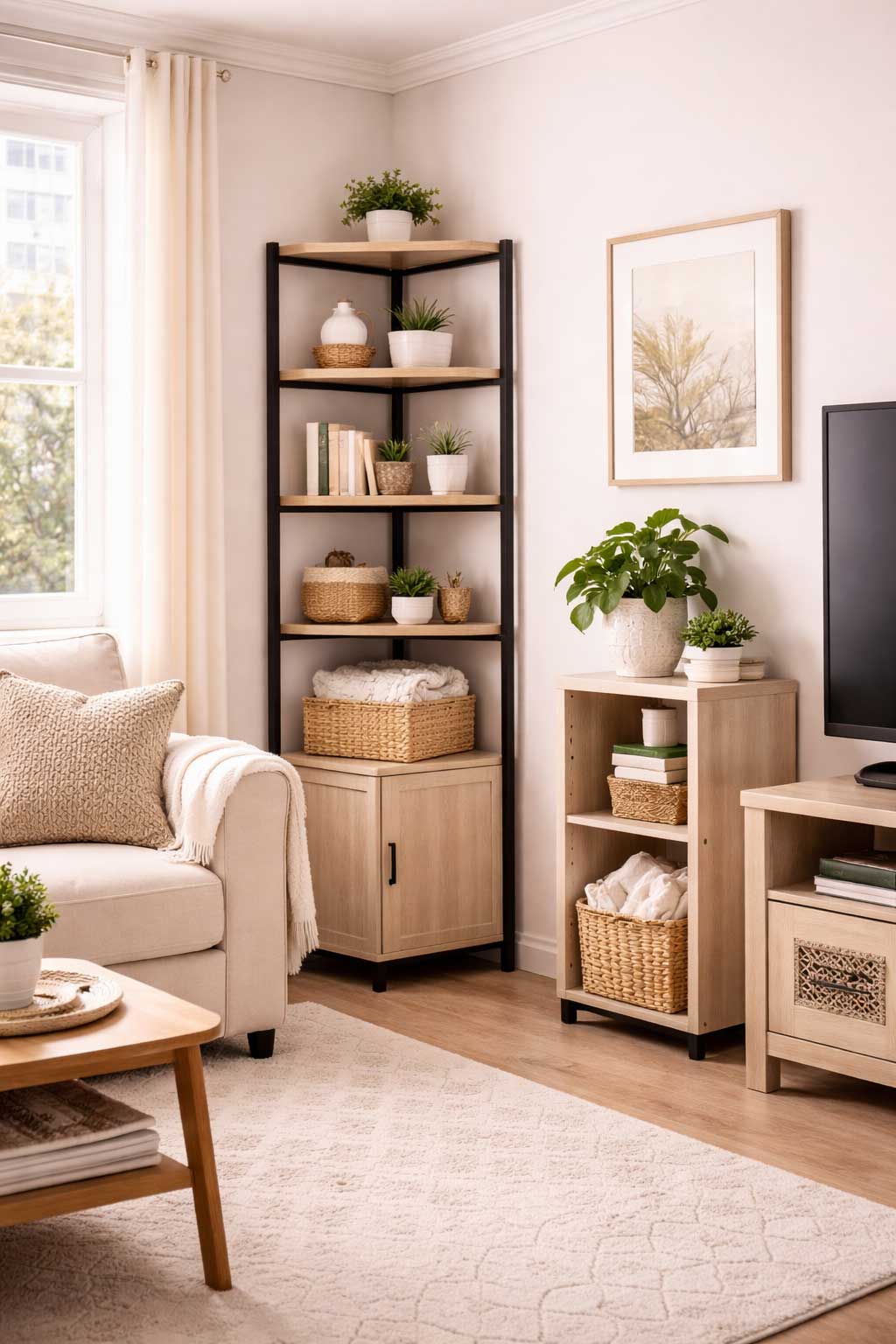
A living room corner may be able to support:
- a vertical shelf for books and baskets
- a compact cabinet
- a narrow ladder shelf
- a media-related piece
- a basket zone for throws or extra pillows
- a corner side table with storage
These kinds of additions can help reduce clutter on coffee tables, media consoles, and open shelves elsewhere in the room. They can also make the room feel more finished because the corner no longer looks forgotten.
That said, living room corners need restraint. A large, heavy piece can make the room feel closed in very quickly. In many apartments, corner storage works best when it stays somewhat open and visually light. If your layout already centers around a TV area, it may also connect naturally with Best Corner TV Stands for Small Apartments when a corner-based media setup makes better use of the room than a straight wall layout.
Bedroom corners are valuable because they can support overflow
Bedrooms in small apartments often have to do more than sleep. They may also be handling clothing overflow, accessories, reading space, work-from-home functions, or extra linens. That makes bedroom corners especially valuable.
A bedroom corner can often be used for:
- a narrow shelf
- a compact chair with a nearby basket
- a small clothing rack
- a corner nightstand alternative
- vertical storage for folded items
- a light storage bench or basket setup
The best use depends on what the room is lacking most. If the closet is undersized, the corner may need to support overflow storage. If the room feels visually empty but storage-starved, a vertical piece may add both balance and function.
In some layouts, bedroom corner storage works best when paired with furniture designed specifically for tighter footprints, which is why it can connect well with Best Corner Bedroom Furniture for Small Spaces. A bedroom corner should feel useful, but it should still preserve enough openness for the room to feel restful.
Kitchen corners often solve storage problems more effectively than expected
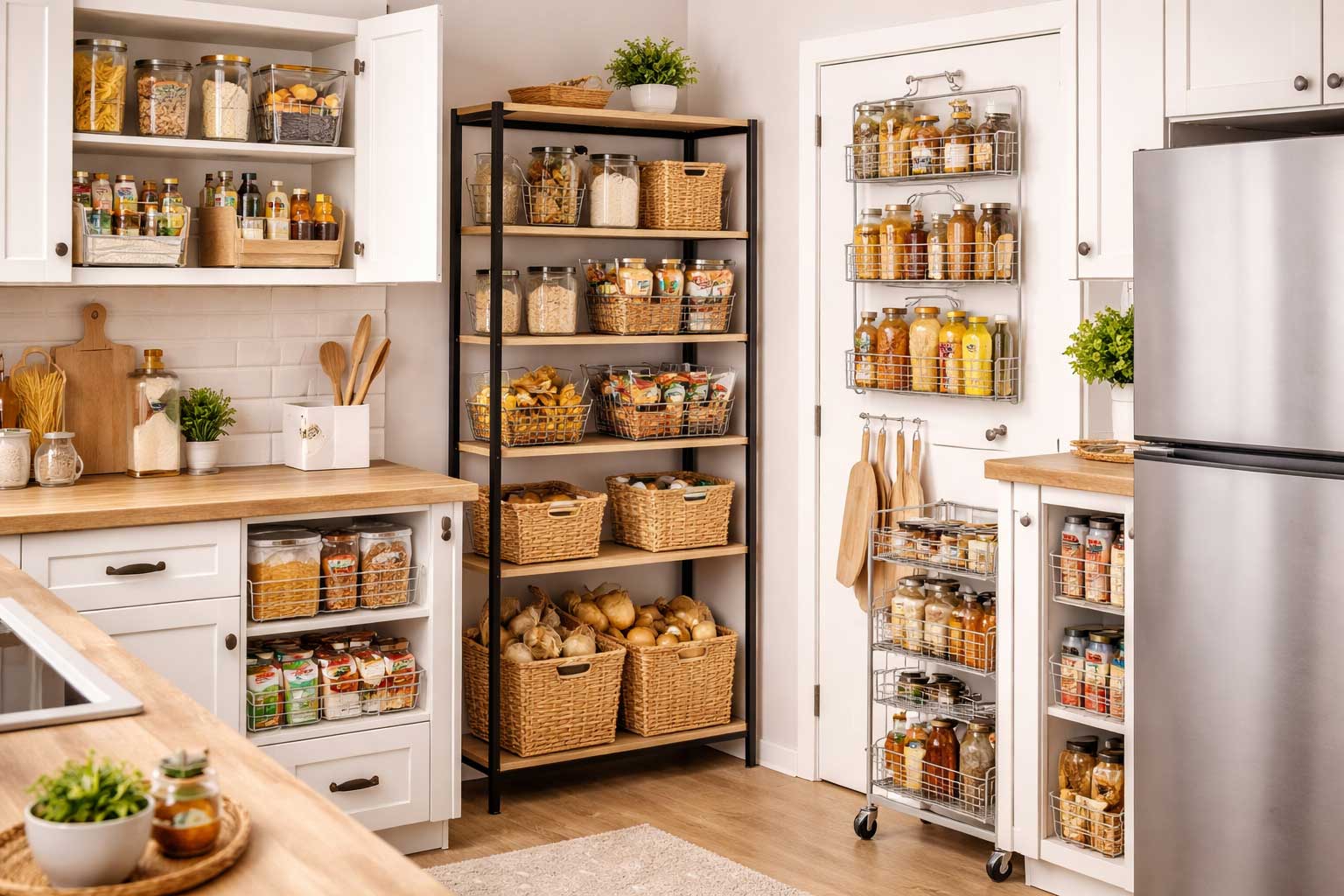
Kitchen corners are some of the most valuable corners in the apartment because kitchens often run out of usable storage first. Counters get crowded, cabinets fill quickly, and pantry items start competing with cookware and dishware. A well-used kitchen corner can relieve that pressure.
Useful kitchen corner ideas may include:
- a compact pantry shelf
- a corner cart
- a small vertical rack
- a coffee or beverage station
- produce baskets
- a narrow utility shelf
- a compact island or freestanding storage piece
These solutions can be especially helpful when the apartment has limited cabinet space and no true pantry. Instead of forcing more into already packed cabinets, a kitchen corner can become a purposeful support zone.
That is why kitchen corners often overlap naturally with Best Corner Kitchen Storage Solutions. In a small apartment kitchen, a single useful corner can dramatically improve everyday function when it holds the categories that no longer fit comfortably elsewhere.
Office corners are ideal for vertical and task-based storage
If your apartment includes a work-from-home area, a corner can be one of the smartest places to build it. Corners often allow desks and storage to fit more naturally into compact layouts, especially when there is not enough room for a wider setup along a full wall.
Office corners may be useful for:
- a compact desk
- floating shelves
- desktop storage
- file boxes
- vertical office organizers
- charging stations
- task lighting
This kind of setup works particularly well when you need storage close to your workstation but do not want the office area to dominate the room. A corner-based arrangement keeps things contained and often opens more usable floor area nearby.
If that is a challenge in your apartment, it also aligns naturally with Best Corner Desks for Small Apartments. In a small home office, the corner is often where function and footprint balance each other best.
Vertical corner storage is usually the most efficient option
In many small apartments, the most effective way to use a corner is to build upward rather than outward. Vertical corner storage helps preserve floor area while still adding meaningful capacity. That is especially helpful in rooms that already feel full at ground level.
Vertical corner storage may include:
- tall shelving
- ladder shelves
- corner étagères
- floating corner shelves
- stacked baskets on shelf units
- narrow tiered storage pieces
The main advantage of vertical storage is that it allows the corner to contribute without turning into a bulky footprint. It also tends to keep more of the room open, which is important in apartments where too many low, wide objects can make everything feel crowded.
This is one reason the same logic from How to Use Vertical Space in a Small Apartment applies so well here. When floor space is limited, vertical corner storage often gives you the best return without sacrificing movement or breathing room.
Corners are good for categories that do not need constant access
Some items are perfect for corners because they benefit from having a home but do not need to be reached every five minutes. That can make the corner feel useful without turning it into a high-traffic stress point.
Good corner-storage categories often include:
- books
- decorative baskets
- folded throws
- backup pantry items
- extra toiletries
- office supplies
- plants paired with hidden storage
- seasonal accessories
- small household extras
Less ideal categories often include:
- very bulky daily-use items
- things that need to be spread out to access
- messy overflow with no categories
- items that create visual chaos in a calm room
The best corner storage usually feels tidy because it holds categories that can stay contained. If you are always digging through the corner or restacking it, the solution may not be right for the space.
Hidden corner storage often works better than open clutter
A corner can add storage without becoming visually loud, but only if the solution matches the room. In some apartments, open corner shelving looks great and feels useful. In others, open storage makes the space feel busier than it needs to.
If the apartment already has a lot of visible items, hidden or partly concealed corner storage may work better. That might mean:
- a cabinet with doors
- baskets tucked into a shelf unit
- a closed storage bench
- a compact piece with drawers
- decorative storage that masks what it holds
This matters because corners often sit at the edge of your visual field. If they are packed with mismatched or overfilled items, they can make the whole room feel unsettled. If they stay neat and intentional, they can quietly support the space without drawing too much attention.
That is especially important if your goal is not just more storage, but a room that still feels open and comfortable. In small apartments, visual calm is part of good organization.
Avoid turning corners into catch-all zones
One of the fastest ways to ruin a corner is to let it become the place where random things collect. A few bags end up there. Then a stack of books. Then a basket of miscellaneous items. Before long, the corner is not “storage.” It is just clutter with a boundary.
To avoid that, every storage corner needs a clear role. That role might be:
- reading corner support
- pantry overflow
- office supply storage
- blanket and basket zone
- entryway support
- media accessory storage
The clearer the role, the easier it is to maintain. A useful corner should answer the question, “What belongs here?” without hesitation.
This is one reason corners work best when they are chosen deliberately, not assigned by default. If the corner only exists to hide random overflow, the system usually collapses quickly.
Corner storage should support the room, not dominate it
In a small apartment, the best storage additions are the ones that feel proportional. A corner unit may be functional, but if it is too deep, too tall for the room, or too visually heavy, it can make the apartment feel tighter instead of better organized.
That is why proportion matters so much. A compact apartment usually benefits more from:
- slimmer lines
- open or airy profiles
- lighter finishes
- narrower footprints
- multi-functional use
- pieces that stay close to the wall angle
A corner should still feel like part of the room, not an oversized attempt to squeeze in more capacity at any cost. When in doubt, choose less bulk and more efficiency.
This also helps the apartment feel bigger visually, which is part of why corner storage should still support broader room openness. If a room already struggles with crowding, it may help to think about the same principles from How to Make a Small Apartment Feel Bigger before adding anything new.
A simple process for choosing the right corner storage
If you want a practical system for deciding how to use a corner, this process works well.
Step 1: Identify the room’s real storage problem
Do not start with the product. Start with the need. Is the room lacking vertical storage, hidden storage, office storage, or overflow control?
Step 2: Evaluate the corner’s location
Check whether the corner is near a walkway, window, outlet, or major furniture piece. Make sure storage there will not interrupt flow.
Step 3: Decide whether the corner should stay open or be used
Some corners are more valuable visually than functionally. That is okay.
Step 4: Choose a category for the corner
Assign one main purpose. Do not build a storage corner around miscellaneous overflow.
Step 5: Choose vertical, concealed, or dual-purpose storage
Pick the style that fits both the room’s needs and the room’s visual feel.
Step 6: Keep the footprint proportional
Make sure the storage does not stick too far into the room or overwhelm nearby furniture.
Step 7: Reassess after using it
If the corner becomes a clutter magnet, adjust what it holds or simplify the system.
This kind of process works because it keeps the corner tied to function instead of impulse.
Common corner storage mistakes to avoid
A few mistakes show up repeatedly in small apartments.
Filling every corner just because it exists
Unused space is not always wasted space. Some openness is valuable.
Choosing pieces that are too bulky
A heavy piece can make the whole room feel tighter, even if it technically adds storage.
Letting the corner become miscellaneous overflow
Corners need categories, not clutter piles.
Ignoring vertical possibilities
Many apartments run out of floor space long before they run out of vertical potential.
Forgetting how the room flows
A good corner solution should support movement and function, not interrupt it.
The best corner storage feels natural, not forced
That is the real goal. A useful corner should feel like it belongs in the room. It should solve a practical problem, reduce pressure on more crowded storage zones, and make the apartment easier to live in without making it feel overfilled.
At its best, corner storage is subtle. It helps a room hold more without looking like it is trying too hard. It makes an awkward dead zone feel functional. It supports daily life while preserving the openness a small apartment needs.