How to Organize a Small Bathroom With No Drawers
Organizing a small bathroom can feel much harder when there are no drawers to hide everyday items. Toothbrushes, skincare, makeup, hair tools, extra toiletries, and cleaning supplies can quickly take over the counter, crowd the sink area, or spill into nearby shelves and cabinets. The challenge is not just finding a place to put things. It is creating a bathroom setup that keeps essentials easy to reach without making the room feel cluttered.
The good news is that a bathroom without drawers can still function well with the right storage plan. In most small apartments, the best setup comes from using vertical space, adding contained organizers, and separating everyday items from backup supplies. With the right approach, you can make a drawer-free bathroom feel much more organized without needing a remodel or bulky furniture.
For broader ideas that work in tight bathrooms, explore our Best Bathroom Storage Solutions for Small Apartments guide.
If your sink and counter are the main problem, check out How to Keep a Small Bathroom Sink Area Organized.
For more compact product options that keep toiletries under control, browse Best Bathroom Counter Organizers for Small Spaces.
This guide is part of our Small Apartment Bathroom Solutions collection.
Quick Answer
If your small bathroom has no drawers, the best way to organize it is to give each category of items its own contained storage spot and keep only everyday essentials near the sink. In most bathrooms, that means using trays, bins, shelves, under-sink organizers, wall storage, and countertop containers to replace the function that drawers would normally provide.
A good no-drawers bathroom setup usually works best when it includes:
- one clear place for everyday toiletries
- separate storage for backup supplies
- vertical or under-sink storage where possible
- limited countertop clutter
- a setup that is easy to reset daily
Why Small Bathrooms Without Drawers Get Cluttered So Fast
Bathrooms without drawers get messy quickly because so many of the items used there are small, frequent-use products. Toothpaste, floss, razors, cotton pads, skincare, makeup, hair ties, and everyday medications are all easy to leave out when there is no hidden place to drop them. Once a few of those items collect on the counter, the whole room starts feeling more crowded.
This gets worse in a small apartment bathroom because the sink area is usually doing too much already. The counter may be tiny, the cabinet may be limited, and the room may not have enough built-in storage to separate daily-use items from extras. Without drawer space, everything competes for the same visible surfaces.
That is why a no-drawers bathroom needs more structure than people expect. The goal is not to find random places to shove things. It is to replace the function drawers would normally provide by giving each category a defined home.
Start by Identifying What Actually Needs to Stay in the Bathroom
One of the easiest ways to make a small bathroom feel more organized is to stop expecting it to hold everything. Not every toiletry, backup product, beauty item, or cleaning supply needs to live there full time.
Start by separating what you use every day from what you only need occasionally. Toothbrushes, face wash, hand soap, and a few daily-use products should usually stay in the bathroom. Backup shampoo, extra toilet paper, duplicate skincare, travel products, and rarely used beauty tools may be better stored elsewhere if the bathroom is very tight.
This matters because a drawer-free bathroom has less room for overflow. If the space is already short on hidden storage, filling it with low-priority items makes the daily routine harder. A smaller group of high-use items is much easier to organize well than a crowded mix of essentials and backups.
Decide Which Items Need Fast Access and Which Can Be Stored Lower or Higher
A small bathroom works better when storage follows your actual routine. The products you reach for every morning and night should be the easiest to grab. Everything else can live a little farther away.
Daily items like a toothbrush, toothpaste, hand soap, face wash, and the few products you use constantly usually belong closest to the sink. Mid-frequency items, like hair tools, makeup, and extra skincare, can go in nearby containers, shelves, or cabinets that are still convenient but not sitting directly on the counter. Backup products and refills can usually go under the sink, on higher shelves, or in closed bins.
This kind of access planning makes a big difference in a no-drawers bathroom because it keeps prime space reserved for the products that actually need it. When everything is equally accessible, the room usually ends up feeling more cluttered than functional.
Choose the Best Storage Type to Replace Drawer Function
Without drawers, the bathroom needs other storage types to create the same kind of separation and control.
Countertop trays and small organizers work well for daily-use items because they keep products grouped instead of scattered. This is especially helpful for toothbrushes, skincare, or a few daily essentials that would otherwise float around the sink.
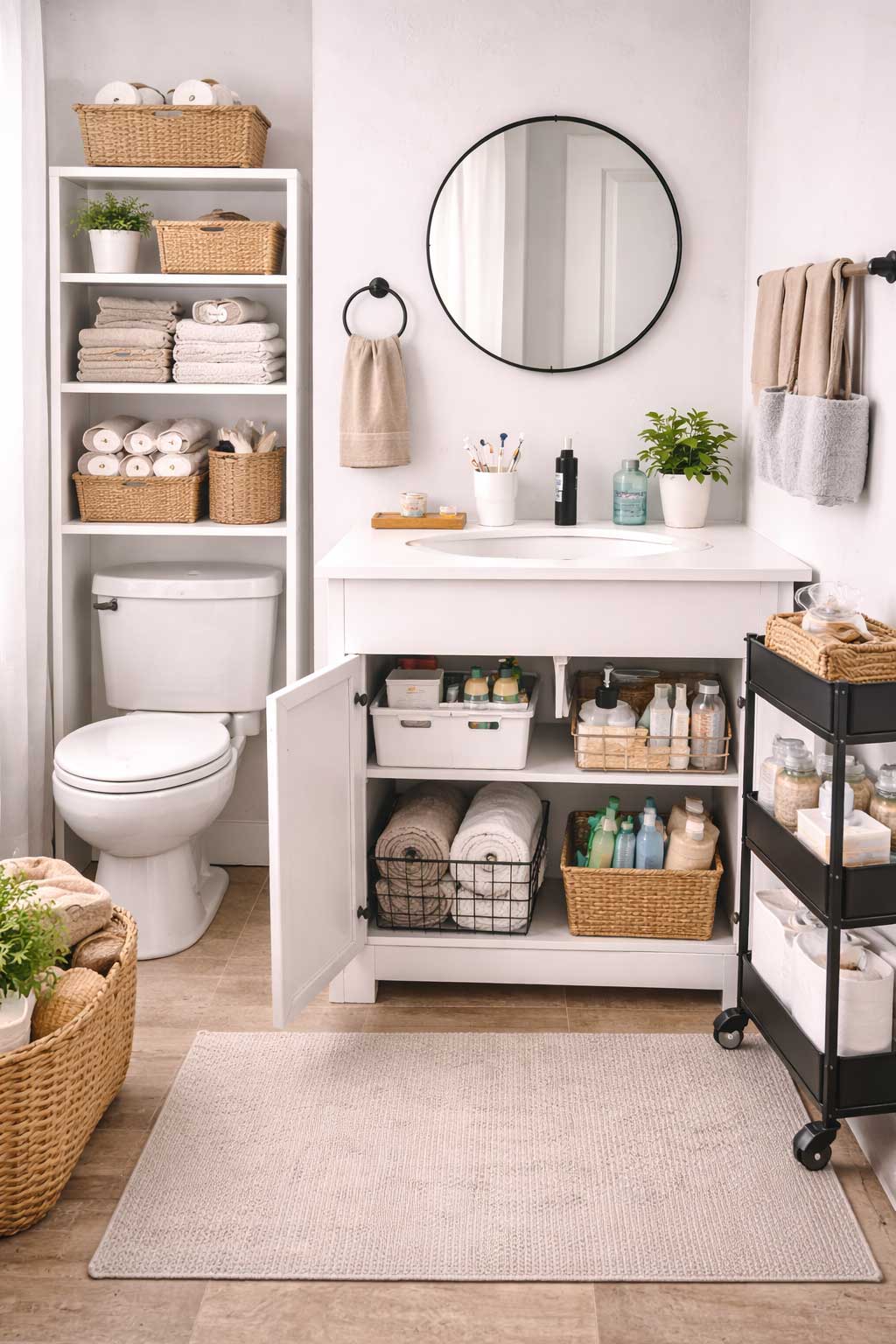
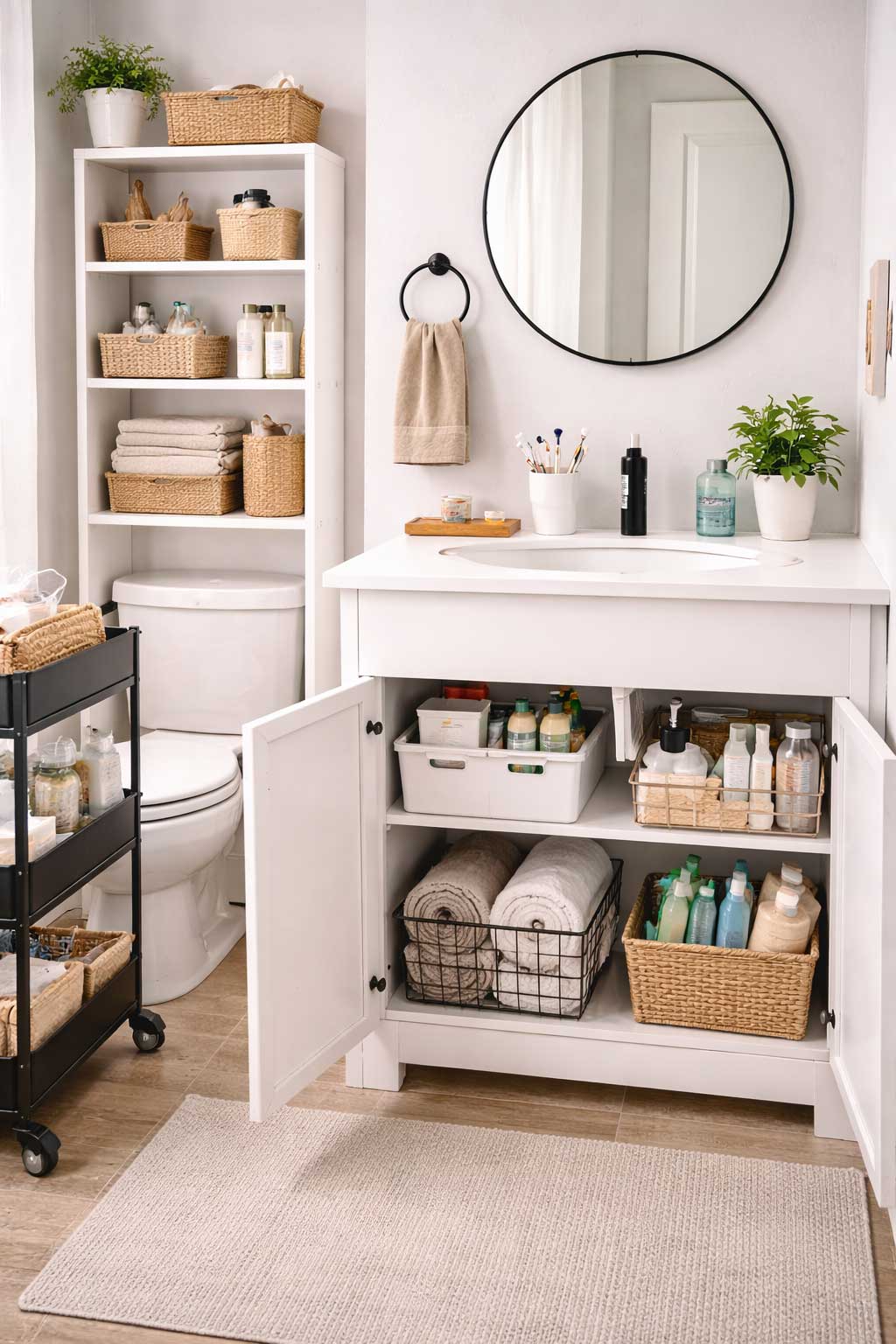
Under-sink bins and risers are often some of the most useful drawer replacements in the room. They create layers and categories inside a cabinet, which makes it easier to separate hair products, toiletries, cleaning supplies, and backup items.
Wall shelves and cabinets can add useful vertical storage when the room lacks built-ins. They work especially well when counter space is limited but the wall area above the toilet or near the vanity can support more organization.
Over-the-toilet storage is often a strong option in bathrooms where floor space is tight but vertical space is underused. This can add meaningful storage without taking over the sink area.
Rolling carts and narrow towers work well in bathrooms that have a small open corner or unused floor strip. These pieces can help when the room needs extra capacity but does not have enough built-in structure to replace drawers on its own.
The key is choosing storage by item category and bathroom layout, not just buying a pile of bins and hoping they work together.
Best No-Drawer Bathroom Setups for Common Small Apartment Layouts
If your bathroom has a pedestal sink and no vanity storage, vertical organization becomes especially important. In that kind of layout, wall shelves, over-the-toilet storage, and compact counter organizers often do the most work because there is almost no hidden space near the sink.
If the bathroom only has a small cabinet under the sink, the best setup usually comes from using that cabinet more intentionally. Bins, risers, and grouped categories can make a basic under-sink area function much more like a drawer system.
If the bathroom is narrow and has almost no counter space, it helps to minimize what stays near the sink. In that kind of layout, even a few products left out can make the room feel messy. A tighter edit paired with vertical storage usually works better than trying to fit too much around the vanity area.
If the bathroom is shared by two people, separation matters a lot more. When both people leave products loose around the sink, the room becomes hard to reset quickly. Dividing products by person or category usually makes the bathroom feel much more manageable.
Keep the Counter Clear So the Bathroom Feels More Organized
The counter is usually the first place a no-drawers bathroom loses control. Once a few products are left out, more tend to follow. Before long, the sink area becomes crowded with toiletries, makeup, hair accessories, and random daily-use items.
That is why limiting what stays on the counter matters so much. In most small bathrooms, only the true everyday essentials should stay there. Even those items usually look better when they are grouped in one tray, cup, or organizer instead of spread across the surface.
A clear counter makes the whole bathroom feel calmer. It also makes cleaning easier, which helps the room stay organized over time. In a small apartment bathroom, visual calm is part of function. The more open the sink area feels, the better the room usually works.
If your sink zone is the main clutter source, revisit How to Keep a Small Bathroom Sink Area Organized for more targeted ideas.
Use Under-Sink and Vertical Space More Efficiently
A bathroom with no drawers usually depends on better use of the space below and above the sink. That means treating the cabinet and wall areas more like active storage zones instead of dumping grounds.
Under the sink, bins and stackers help create structure that drawers would normally provide. Rather than tossing products into one open cabinet, you can group them by use: hair products in one bin, dental extras in another, cleaning supplies in another. Even simple separation makes it easier to find things and prevent clutter from spreading.
Above the sink or toilet, wall cabinets, shelves, or other vertical storage can create space for products that would otherwise crowd the vanity. This is especially helpful in bathrooms with minimal floor space. The goal is to use height in a controlled way so the room holds more without feeling heavier.
If you need more ideas for using the space below the sink well, check out How to Organize Under-Sink Space in a Small Apartment.
If your layout can support storage over the toilet, browse Best Over-the-Toilet Storage Solutions for Small Bathrooms.
Make Shared Bathroom Storage Work Without Drawers
Shared bathrooms get cluttered faster because the same small area has to support twice as many routines. Without drawers, it becomes even more important to create clear divisions so products do not all end up mixed together.
One of the easiest ways to do this is by assigning bins, shelves, or sections. That might mean one tray per person on the counter, one side of the under-sink cabinet for each person, or separate bins for toiletries and grooming products. The details do not need to be complicated, but the boundaries should be obvious enough that the setup stays usable.
This also helps reduce duplicate clutter. In a very small bathroom, not every backup or secondary product needs to live near the sink. Shared bathrooms usually work best when the room supports the current routine and overflow items are stored elsewhere.
If your bathroom needs more enclosed vertical storage, take a look at Best Small Bathroom Wall Cabinets.
Mistakes to Avoid When Organizing a Small Bathroom With No Drawers
One common mistake is leaving too many products on the counter. This usually makes the bathroom feel messy no matter how clean it actually is. Another issue is storing backup supplies with daily-use items, which makes prime space harder to use efficiently.
Using too many tiny organizers can also backfire. While some smaller containers help, a bathroom full of cups, bins, trays, and baskets can start feeling more cluttered rather than less. In small spaces, fewer better-defined storage pieces usually work better.
Ignoring vertical space is another big mistake. When there are no drawers, the room often needs shelves, cabinets, or taller storage to compensate. Finally, many people keep too many items in the bathroom that do not need to live there at all. The more selective the room is about what stays, the easier it becomes to organize well.
Products That Make a No-Drawers Bathroom Easier to Organize
The best products are the ones that replace drawer function without making the room feel busier. Some bathrooms do best with countertop trays and sink organizers that keep the daily routine under control. Others benefit more from under-sink bins, shelves, or stackers that create hidden storage. In tighter layouts, over-the-toilet units, wall cabinets, narrow towers, or rolling carts may make the biggest difference.
The right solution depends on what the bathroom is missing most. If the counter is overwhelmed, the answer may be a stronger sink-area system. If backups are the problem, under-sink or vertical storage may matter more. In a small apartment bathroom, the best storage usually works because it gives each category a place instead of letting everything compete for one small surface.
Final Thoughts on Organizing a Small Bathroom With No Drawers
A small bathroom with no drawers can still feel organized when the room has enough structure to replace what drawers normally do. That usually means keeping everyday items close, moving backups out of the way, and using under-sink and vertical storage more intentionally.
The strongest setups usually come from a few smart decisions: edit what actually needs to stay in the room, keep the counter as clear as possible, and group products by category instead of leaving them loose. When those pieces come together, even a drawer-free bathroom can feel much easier to use.
The goal is not to squeeze more random storage into the room. It is to create a setup that supports your daily routine without making the bathroom feel more crowded.
FAQ
How do you organize a small bathroom with no drawers?
Organize a small bathroom with no drawers by using trays, bins, shelves, under-sink organizers, and vertical storage to give each category of items its own defined place.
Where do you put toiletries if your bathroom has no drawers?
Toiletries in a bathroom with no drawers usually work best in countertop organizers for daily-use products, under-sink bins for backups, and shelves or cabinets for categories that do not need immediate access.
How do you keep a bathroom counter organized without drawer storage?
Keep a bathroom counter organized without drawer storage by limiting what stays out, grouping daily-use products in one tray or organizer, and moving backup or low-use items into hidden storage elsewhere.
What storage works best under a bathroom sink?
The best storage under a bathroom sink usually includes bins, risers, stackers, and grouped containers that create structure inside the cabinet and make it easier to separate product categories.
How do you organize a shared bathroom with limited storage?
Organize a shared bathroom with limited storage by assigning sections, bins, trays, or shelves to each person so products do not overlap and daily-use items stay easier to manage.