How to Make a Narrow Apartment Hallway More Functional
A narrow apartment hallway can feel like wasted space when it is too tight for standard furniture but still needs to handle daily life. Shoes, bags, coats, umbrellas, and random clutter often end up creeping into the walkway, making the hall feel even smaller and more frustrating to use. The challenge is not just fitting storage into a narrow area. It is making the hallway more useful without blocking movement or making the apartment feel cramped.
The good news is that a narrow hallway can still become a functional part of a small apartment. The best setups usually come from choosing shallower storage, using wall space carefully, and limiting what actually needs to live there every day. With the right approach, even a tight hallway can work harder without feeling crowded.
For broader front-door organization ideas, explore our Best Entryway Storage Solutions for Small Apartments guide.
If you need furniture designed for tighter passageways, check out Best Entryway Furniture for Narrow Apartment Hallways.
For wall-based options that take up less floor space, browse Best Wall Hooks for Small Apartment Entryways.
This guide is part of our Small Apartment Entryway Solutions collection.
Quick Answer
If you want to make a narrow apartment hallway more functional, the best approach is to use the walls and the shallowest possible storage while keeping the walkway clear. In most apartments, that means choosing slim furniture, limiting floor clutter, and giving everyday items like shoes, coats, or keys one defined place instead of letting them spread through the hall.
A more functional narrow hallway usually works best when it includes:
- storage that is shallow enough to preserve walking space
- one clearly defined purpose for the hallway
- wall-based or vertical storage where possible
- limited floor clutter
- a layout that still feels easy to move through
Why Narrow Apartment Hallways Feel So Hard to Use
Narrow hallways feel difficult fast because there is very little margin for error. In a wider room, a basket, shoe tray, or small cabinet may barely register. In a tight hallway, the same item can make the whole space feel constricted. Even a few pairs of shoes or a bag set on the floor can change how easy the hallway is to walk through.
Part of the problem is that hallways often become default storage areas without anyone meaning for that to happen. They sit between rooms, near the front door, or beside the bathroom, so they attract whatever does not have a better home. That might be coats, shoes, reusable bags, extra paper towels, or random items that were only supposed to stay there “for now.”
This is why making a narrow hallway more functional starts with control, not just furniture. If the space is already struggling with clutter, adding more pieces without a clear plan usually makes it worse. The goal is to make the hallway work better while protecting the open path through it.
Start by Deciding What the Hallway Actually Needs to Do
A narrow hallway works better when it has one clear job. Some hallways need to support the entryway. Others need to hold shoes near the front door. Some need better lighting and a cleaner drop zone. Others mostly need to stop becoming accidental overflow storage.
This is an important first step because a hallway usually cannot do everything well. If you try to make it a shoe zone, coat zone, mail station, décor moment, and overflow storage spot all at once, the walkway gets crowded fast. A better approach is to figure out which one problem would make the biggest difference if solved.
If the hallway is next to the front door, its main job may be handling entry clutter. If it connects bedrooms and the bathroom, it may need better lighting and less visual mess. If it doubles as a studio entry, it may need to serve as a compact landing zone. Once the purpose is clear, it becomes much easier to choose the right upgrade.
Measure for Walking Space Before Adding Anything
This is one of the most important parts of improving a narrow hallway. A piece can look slim online and still feel too bulky once it is placed in a real apartment. That is why hallway measurements need to focus on movement, not just whether furniture technically fits.
Measure the width of the hall, but also account for door swings, trim, baseboards, radiators, vents, and outlets. Check what happens when doors are open. Think about how people actually pass through the space while carrying bags, laundry, groceries, or other everyday items. In a tight hallway, even a few extra inches of depth can matter a lot.
Depth is usually the biggest issue. A shallow cabinet or narrow shelf may work well, while a standard console or bench may feel too large even if it fits on paper. The best hallway additions preserve the feeling of passage first and add function second. If the hallway becomes awkward to walk through, the solution is not really helping.
Choose the Best Functional Upgrade for Your Hallway Layout
The best upgrade depends on what the hallway is missing.
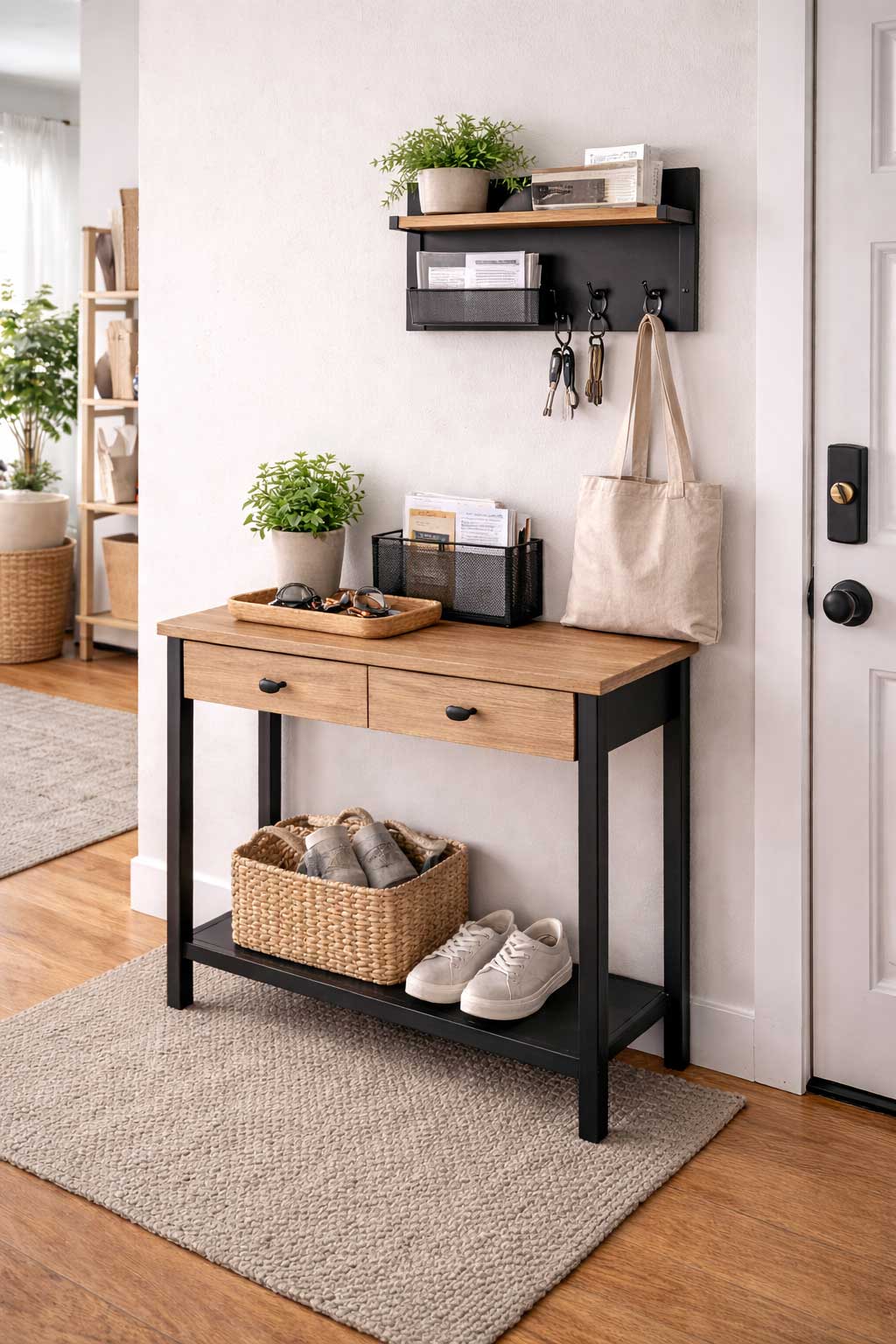
Wall hooks are often the strongest option when there is almost no floor space. They can hold coats, bags, or reusable totes without narrowing the walkway much. They work especially well when the hallway is near the front door and needs a little more utility without a furniture footprint.
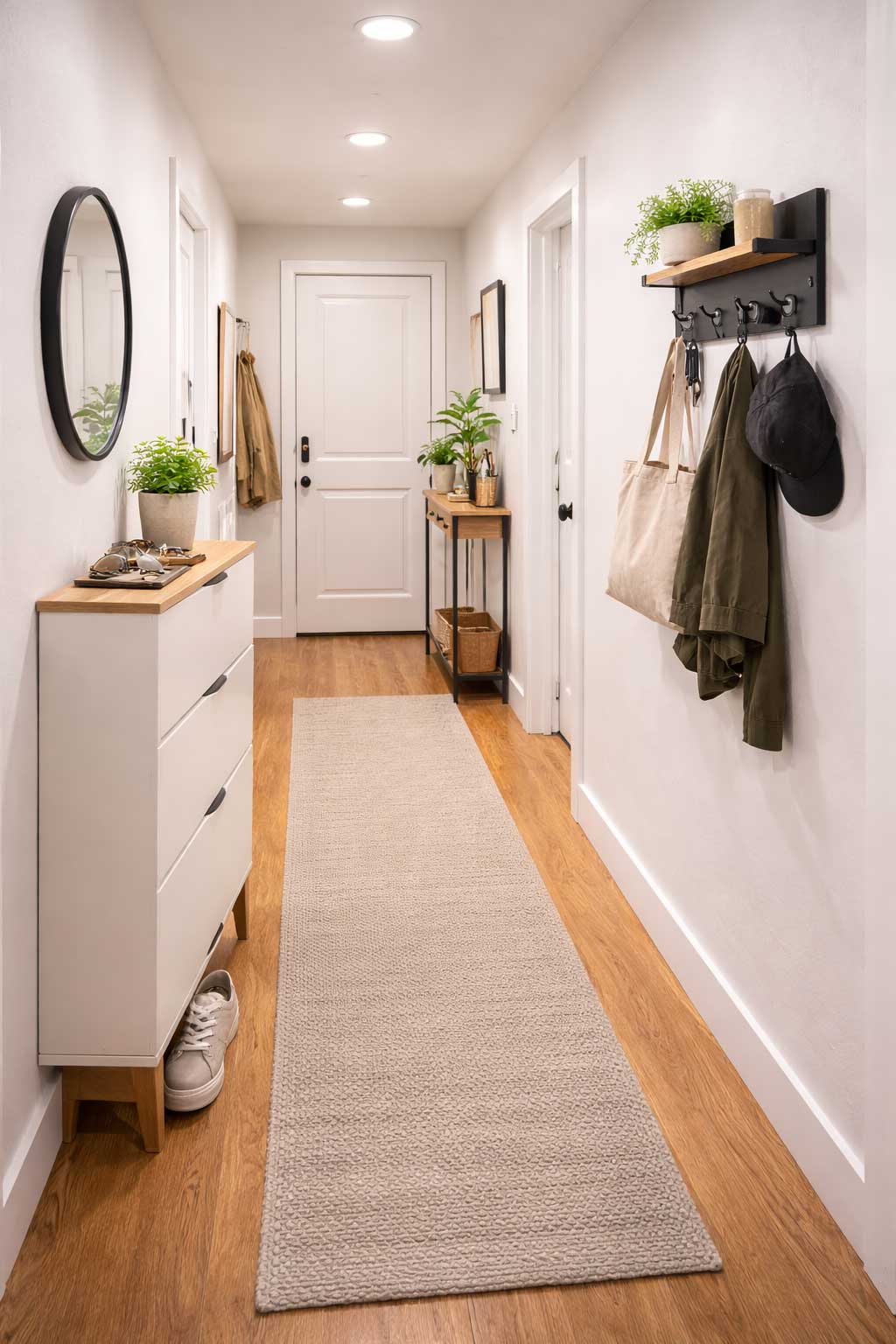
Shallow shoe cabinets are a strong fit for entry-adjacent hallways. They contain one of the biggest clutter categories without sticking out as far as a regular shelf or bench. In many apartments, solving shoe clutter alone makes the whole hallway feel much better.
Narrow consoles or shallow shelves can work well if the hall needs a drop zone for keys, mail, and other small daily items. These are best in layouts where there is just enough width for a slim piece that still leaves comfortable walking room.
Mirrors and better lighting can be the right answer when the hallway is functional enough but still feels dark, tight, or unfinished. Sometimes the biggest improvement is not more storage. It is making the space easier to see and more pleasant to move through.
Runners or other visual styling choices can help define the hall without adding bulk, especially if the goal is to make the space feel more intentional. But those are usually best after the main clutter problem has already been solved.
Best Ways to Make a Narrow Hallway More Functional in Different Apartment Setups
If the hallway sits by the front door, it often works best as a limited entry-support zone. In that kind of setup, the hallway may benefit most from shoe control, a few hooks, or one shallow piece for everyday essentials. The key is keeping the functions tightly edited so the entrance does not spill into the path.
If the hallway connects bedrooms and the bathroom, the biggest upgrades are often lighting, better wall use, and clutter control. This kind of hall usually does not need heavy storage. It needs to stay visually calm and easy to move through, especially during everyday routines like getting ready in the morning or carrying laundry.
If you live in a studio apartment and the hallway doubles as entry space, the setup needs to do more with less. In that case, a small number of carefully chosen pieces usually works better than several small organizers. The hallway should support daily life without making the whole apartment feel more crowded.
If the hallway has multiple doors opening into it, clearance becomes even more important. In these layouts, a wall-based solution or very shallow furniture usually works better than anything with depth. The more doors there are, the less tolerance the space has for bulky storage.
Use Vertical Space Without Making the Hallway Feel Heavier
Vertical storage is one of the smartest ways to improve a narrow hallway, but it still needs restraint. Wall hooks, shelves, mirrors, and lighting can all add function without taking up much floor space. The danger is that too much wall storage can make the hallway feel visually heavy even if the floor stays open.
The best vertical setups are usually the simplest ones. A few hooks for daily coats or bags can work well. One mirror can help the space feel brighter and more open. A small shelf for keys or mail may be enough if the hallway is part of the entry area. Taller, slimmer pieces can also work in some layouts, but only if they do not dominate the space.
What usually does not work is treating every section of wall like storage real estate. Once the walls are crowded with hooks, shelves, baskets, and art, the hallway can feel tighter even if it is technically organized. In narrow spaces, controlled vertical storage is usually much more effective than maximum vertical storage.
Keep Shoes, Bags, and Everyday Clutter From Taking Over the Floor
The floor matters most in a narrow hallway. Once shoes, bags, or random items start collecting there, the hallway loses a lot of its usefulness immediately. What could have felt like a simple passage starts feeling like an obstacle course.
That is why containment is so important. Shoes need a defined place rather than sitting loose along the wall. Bags should live on hooks, in a cubby, or in another controlled storage zone instead of landing on the floor. Everyday clutter should be handled at the source instead of slowly spreading into the hallway because there is nowhere else for it to go.
In many apartments, the biggest functional improvement comes from floor control alone. If the hallway can stay mostly clear at ground level, it instantly feels more usable and less stressful. That is often a bigger win than adding more decorative touches or trying to make the space do too many jobs.
If shoes are the main problem in your layout, see Best Shoe Cabinets for Narrow Apartment Entryways.
If the hallway needs a more defined landing zone for daily essentials, take a look at Best Drop Zone Organizers for Small Apartment Entryways.
Improve Lighting and Visual Openness So the Hallway Feels More Usable
A narrow hallway that feels dark or closed in often feels less functional, even if the storage is technically fine. When a hallway is dim, visually cluttered, or full of heavy-looking pieces, it tends to feel more like a problem area than a useful one.
Lighting helps more than people expect. A brighter bulb, better wall light, or even a more reflective mirror can make a tight hallway feel easier to use. Lighter finishes and simpler wall styling can do the same thing. The goal is not to make the hallway look staged. It is to reduce the sense of compression that narrow spaces often create.
Visual openness also comes from editing. Fewer items on display, lighter-looking storage, and cleaner surfaces all help the hallway feel wider than it is. In small apartments, this kind of visual relief is part of function. A hallway that feels lighter is usually easier to use.
Mistakes to Avoid When Trying to Make a Narrow Hallway More Functional
One common mistake is adding furniture that is too deep. Even if a piece looks attractive or seems useful, it can make the hallway feel frustrating every single day if it narrows the path too much.
Another mistake is using the hallway as overflow storage. This happens easily because hallways are transitional spaces, but once extra items start living there permanently, the area quickly stops functioning well.
Too many hooks, shelves, or decorative pieces can also become a problem. Wall-based storage is helpful, but overdoing it can make the hallway feel crowded from top to bottom. In narrow spaces, a little usually goes much farther than people expect.
Finally, many people focus on décor before solving the real clutter issue. A runner, mirror, or framed print can help, but not if the floor is still covered in shoes and the hallway is still catching random overflow. Function has to come first.
Products That Make a Narrow Apartment Hallway More Functional
The best products are the ones that solve the hallway’s main problem without overwhelming the space. Some narrow halls benefit most from shoe cabinets that keep clutter contained in a shallow footprint. Others work better with hooks, mirrors, or slim shelves that add function without reducing walking room. In some apartments, better lighting is what makes the hallway feel more usable.
If your hallway needs a fuller entry setup that still stays compact, browse Best Hall Trees for Small Apartments.
The right upgrade depends on how the hallway is used, how much width you really have, and which clutter category is causing the most frustration. In a narrow apartment hallway, the best changes are usually the ones that feel simple once they are in place.
Final Thoughts on Making a Narrow Apartment Hallway More Functional
A narrow apartment hallway becomes more functional when it stops trying to hold everything and starts supporting one clear purpose well. That might mean better shoe control, better wall use, stronger lighting, or a more defined entry setup. Whatever the solution is, it needs to protect walking space first.
The strongest hallway upgrades are usually the simplest. They use shallow storage, keep the floor clear, and make the space feel lighter rather than heavier. When those pieces come together, even a tight hallway can become noticeably easier to use.
A narrow hallway does not need to be wasted space. It just needs a setup that works with the limits of the layout instead of fighting them.
FAQ
How do you use a narrow apartment hallway better?
Use a narrow apartment hallway better by giving it one clear purpose, using shallow or wall-based storage, and keeping the floor as open as possible so the space stays easy to move through.
What furniture works in a narrow hallway?
The best furniture for a narrow hallway usually includes shallow shoe cabinets, slim consoles, very narrow shelves, and other low-depth pieces that add function without blocking movement.
How do you keep a narrow hallway from feeling cluttered?
Keep a narrow hallway from feeling cluttered by limiting floor items, choosing lighter-looking storage, controlling wall clutter, and making sure everyday items like shoes or bags have one defined place.
Can you put storage in a narrow apartment hallway?
Yes, you can put storage in a narrow apartment hallway, but it usually works best when the storage is shallow, wall-based, or carefully chosen to preserve enough walking space.
How do you make a narrow hallway feel wider and more functional?
Make a narrow hallway feel wider and more functional by improving lighting, using mirrors or lighter finishes, reducing visible clutter, and choosing storage that helps the space without crowding it.