How to Store Small Appliances in a Small Apartment Kitchen
Small appliances can take over an apartment kitchen fast. A coffee maker, toaster, blender, air fryer, rice cooker, and microwave may all feel useful, but in a compact kitchen they can quickly crowd the counters, fill cabinets awkwardly, and make everyday meal prep harder. In many apartments, the challenge is not just owning too many appliances. It is figuring out where to keep them so the kitchen still feels usable.
The good news is that small appliances can be stored much more efficiently when you separate daily-use items from occasional-use ones and build a storage system around how you actually cook. The best setups usually combine better cabinet use, vertical storage, carts, and dedicated appliance zones that keep the counters from becoming permanent storage space. With the right setup, a small apartment kitchen can stay functional without forcing you to give up the appliances you actually use.
For flexible appliance overflow storage, start with Best Small Kitchen Appliance Carts.
If you need a dedicated support surface, check out Best Compact Microwave Stands.
For extra vertical kitchen storage, see Best Countertop Storage Shelves for Small Kitchens.
This guide is part of our Small Kitchen & Dining Solutions collection.
Why Small Appliances Create Clutter So Quickly in a Small Apartment Kitchen
Small appliances become a problem quickly because they take up much more usable space than people expect. A toaster or coffee maker may seem small on its own, but when several appliances live on the counter at once, they shrink the prep area fast. In a compact apartment kitchen, losing even part of the counter can make cooking feel more cramped and less efficient.
The shape of small appliances also makes storage harder. They are often bulky, heavy, and awkward to stack. Unlike dishes or pantry items, they do not fit neatly into every cabinet. Handles, lids, bases, and cords make them harder to tuck away cleanly, which is why they often end up sitting out longer than they should.
This clutter builds even faster when appliances do not have designated zones. If the blender lives wherever it fits one day and the air fryer moves somewhere else the next, the kitchen starts feeling like a collection of temporary decisions instead of a usable system. In a small apartment, better appliance storage is really about protecting the kitchen’s daily function.
Start by Deciding Which Appliances Deserve Counter Space
Not every appliance should stay out all the time. One of the easiest ways to improve a small kitchen is to decide which machines actually earn permanent or semi-permanent counter space based on real daily habits. That decision alone can make the room feel more open almost immediately.
Daily-use appliances should be the easiest to reach. If you use your coffee maker every morning or your toaster almost every day, it makes sense for those to stay in the most convenient zone. But if the blender is used twice a month or the slow cooker comes out only on weekends, those items usually do not deserve prime counter space.
The best plan depends on how you actually cook, not on how the kitchen looks in a product ad. A compact kitchen works better when the appliances closest to the prep and cooking area are the ones that support your routine most often. Everything else can be stored nearby without living front and center every day.
Keep Counters Clearer by Creating Appliance Zones
A small apartment kitchen feels much better when appliances are grouped with intention instead of scattered around wherever they happen to fit. Appliance zones help the kitchen feel more organized and stop the counter from turning into general storage.
Coffee and beverage appliances are one of the easiest categories to group together. If the coffee maker, grinder, pods, mugs, and sugar all share one defined area, the setup feels more compact and less disruptive to the rest of the kitchen. If you want a better way to keep beverage appliances contained, browse Best Compact Coffee Stations for Small Kitchens.
It also helps to keep appliances from competing with the main prep zone. The stretch of counter closest to chopping, mixing, and everyday food prep should stay as open as possible. Appliances that are not used during actual meal prep should live farther away from that area whenever possible. A small kitchen feels much more functional when each section has a purpose instead of every machine trying to live in the same high-value space.
Use Lower Cabinets and Pantry-Style Storage More Intentionally
Some appliances belong inside cabinets, but only when the storage still feels practical. A heavy appliance shoved into the very back of a deep lower cabinet is not really well stored if pulling it out becomes annoying every time you need it. Lower cabinets work best when the pieces inside are organized with more thought than just “put the bulky things down low.”
Heavier appliances usually need stable, easy-to-reach storage. That may mean the bottom shelf of a pantry cabinet, a dedicated lower cabinet section, or a roomy enclosed area where the appliance can be lifted safely without twisting around other items. If you need a better closed-storage option for overflow appliances, see Best Small Kitchen Pantry Cabinets.
The same principle applies to general cabinet use. Appliances should not be stacked randomly with lids, accessories, and unrelated kitchen items mixed around them. When lower storage is structured better, it becomes much easier to keep the kitchen feeling calm. The goal is not just to get appliances off the counter. It is to store them in a way that still supports daily use.
Use Appliance Carts and Microwave Stands for Overflow
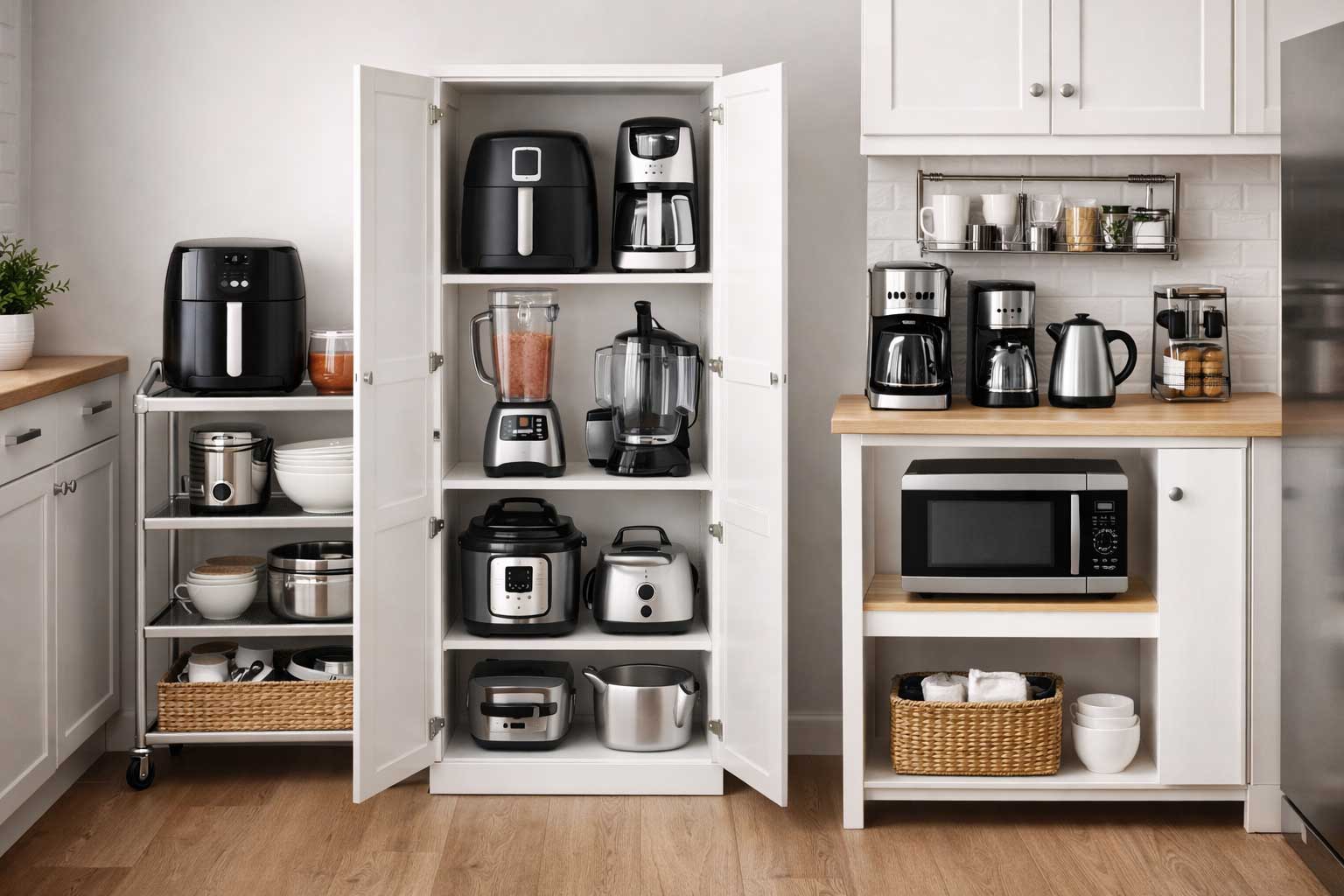
When the built-in cabinets are not enough, carts and appliance stands are often the easiest solution. They add useful storage without requiring a remodel, and they work especially well in apartments where the kitchen layout is fixed and already short on support surfaces.
Appliance carts can hold bulkier everyday machines like air fryers, coffee setups, or mixers while keeping them close enough to use comfortably. They are often more practical than trying to force one more appliance into an already overloaded cabinet. If your kitchen needs flexible overflow support, take a look at Best Small Kitchen Appliance Carts.
Microwave stands can also make a big difference because they move one of the bulkiest appliances off the main counter while creating extra storage space around it. For tighter kitchens that need a dedicated support piece, check out Best Compact Microwave Stands.
The key is placement. Secondary storage should still feel connected to the kitchen workflow. If the cart or stand is too far away or blocks movement, it becomes a burden instead of a help. In a small apartment, the best support storage is close enough to feel natural but separate enough to relieve pressure from the main prep zone.
Use Vertical Storage to Support Small Appliance Storage
Vertical storage is often the best way to keep appliances accessible without sacrificing too much counter space. In many small kitchens, the answer is not more floor furniture. It is using the airspace above the counter more effectively.
Countertop shelves can add another layer of storage above smaller appliances, letting you stack function vertically instead of spreading everything wider. This works especially well for lighter categories like mugs, coffee supplies, or small accessories that support the appliances below. If you want to build upward more efficiently, browse Best Countertop Storage Shelves for Small Kitchens.
Wall-mounted kitchen storage can also help move accessories and support items off the counter completely. When vertical storage is used well, it protects the work surface while keeping key items nearby. The important part is keeping it edited. Too much stacked shelving can make a small kitchen feel busier instead of cleaner, so the setup should support the appliances without overwhelming the room.
Make Cords and Accessories Part of the Storage Plan
Appliance storage often feels messier than it should because the cords and accessories are never fully accounted for. Even when the appliance itself has a place, a loose power cord, blender attachment, measuring cup, or extra tray can make the storage zone feel chaotic again.
That is why appliance storage should include all the smaller pieces that go with the machine. If the air fryer basket accessories live in one place, the blender attachments in another, and the cords are wrapped or contained properly, the whole kitchen becomes easier to maintain. If you need better support for smaller appliance-related items, take a look at Best Kitchen Drawer Organizers.
A cleaner appliance setup also makes the appliances easier to use. When you do not have to untangle a cord or hunt for an attachment every time you pull something out, the storage system is working with your routine instead of against it. In a small apartment kitchen, those details matter more than people think.
Keep the Storage Easy to Reset After Daily Use
The best appliance storage systems reduce friction. If the setup makes it hard to put a machine away, it will probably stay on the counter longer than intended. That is why appliance storage should match how you actually use the kitchen on normal days.
Every appliance should have an obvious return spot. If it takes too much rearranging to put the toaster away or the blender does not clearly belong anywhere, the storage plan is too complicated. A small kitchen usually stays more functional when the system is simple enough that you can reset it quickly without thinking too much.
This matters after cooking, but it also matters in the morning rush, at the end of the day, and during casual everyday use. A cleaner kitchen is not always the one with fewer items. It is often the one where everything can return to its place without a fight.
Common Mistakes That Make Small Appliance Storage Harder
One common mistake is leaving too many appliances out full time just because they are useful sometimes. Even a few “kind of regular” appliances can eat up the whole counter quickly. Another mistake is storing heavy appliances in awkward high cabinets where getting them down feels unsafe or frustrating.
People also often let appliances crowd the main prep area, which makes the kitchen less functional even if everything technically has a place. Ignoring cords, attachments, and accessories is another major problem. A machine is not truly stored well if all its smaller parts are floating around separately.
The best appliance storage setups avoid these traps by keeping the daily-use pieces accessible, the occasional-use items out of prime space, and the messy little extras under control. In a small apartment, that kind of discipline is what keeps the kitchen usable.
Best Features to Look for in Small Appliance Storage for Apartment Kitchens
When choosing appliance storage for a small apartment kitchen, compact footprint should be one of the first priorities. Any support piece needs to add function without swallowing the room. Stable surfaces are also important, especially for heavier machines like microwaves, mixers, and air fryers.
Vertical storage value matters a lot too. The more a piece can build upward instead of outward, the more likely it is to help a compact kitchen. Easy access is equally important. Storage should not make appliances so inconvenient to reach that they end up permanently back on the counter.
Apartment-friendly flexibility is what ties it all together. The best appliance storage can adapt to different routines, different machine sizes, and different layouts without feeling too rigid. In a small kitchen, the right storage usually earns its place by staying practical every day.
Final Thoughts on Storing Small Appliances in a Small Apartment Kitchen
A small apartment kitchen can absolutely handle useful small appliances, but only when the storage system is built around real cooking habits. The best setups keep daily-use machines accessible, move occasional-use appliances out of prime counter space, and protect prep areas from becoming permanent storage.
When appliances are grouped into sensible zones, supported by carts or stands when needed, and backed up by better vertical and cabinet storage, the kitchen starts working much more smoothly. Instead of feeling crowded by machines, the room feels more intentional.
The goal is not to hide every appliance. It is to store them in a way that keeps the kitchen functional. In a compact apartment, that balance makes the difference between a kitchen that feels cramped and one that still feels easy to cook in.
Our Top Small Appliance Storage Picks for Apartment Kitchens
Small appliances are easiest to manage when storage keeps daily-use machines accessible, occasional-use ones out of prime counter space, and support items grouped more intentionally. The best solutions usually stay compact, sturdy, and flexible enough for apartment kitchens.
Best overall choice:
Small kitchen appliance cart — An appliance cart gives bulky machines a dedicated home without taking over the main counter.
👉 Check price on Amazon
Best support-surface upgrade:
Compact microwave stand — A microwave stand helps move large appliances off the main prep area while adding useful secondary storage.
👉 Check price on Amazon
Best vertical solution:
Countertop storage shelf — A countertop shelf helps build storage upward so smaller appliances and their supplies do not spread across the whole counter.
👉 Check price on Amazon
Best cabinet-accessory solution:
Kitchen drawer organizer — A drawer organizer helps keep cords, attachments, and smaller appliance parts from becoming clutter.
👉 Check price on Amazon
Kitchens with very limited built-in storage may also benefit from a pantry cabinet or a wall-mounted rack, especially when the goal is to keep appliances accessible without giving up too much prep space.
FAQ
How do you store small appliances in a small kitchen?
The best way to store small appliances in a small kitchen is to keep daily-use items in the most accessible zones, move occasional-use appliances into cabinets or support furniture, and use carts or vertical storage when counters are too crowded.
Which appliances should stay on the counter?
The appliances that should stay on the counter are usually the ones you use most often, such as a coffee maker or toaster, while less-used appliances can usually be stored elsewhere.
What is the best storage for small kitchen appliances?
The best storage for small kitchen appliances usually includes appliance carts, microwave stands, pantry-style cabinets, and countertop shelving that supports access without crowding prep space.
How do you keep appliances accessible without losing prep space?
Keep appliances accessible without losing prep space by grouping them into zones, using secondary storage like carts or stands, and keeping the main prep counter reserved for the tasks you do every day.