How to Store Reusable Containers and Lids in a Small Apartment Kitchen
Storing reusable containers and lids in a small apartment kitchen can get messy fast. Food storage containers are useful every day, but they are also one of the easiest categories to lose control of. Lids slide around, containers get stacked with the wrong sizes, and one crowded cabinet can quickly turn into a frustrating pile that wastes time every time you need to pack leftovers or put dishes away. The challenge is not just finding somewhere to keep containers. It is creating a system that makes the sets easy to match, easy to grab, and easy to put back without eating up too much cabinet space.
The good news is that container storage does not need a huge kitchen to work well. In most small apartments, the best setup comes from separating lids from containers, keeping only the sizes you actually use, and using dividers or bins that stop the whole category from collapsing into one messy stack. With the right approach, even a small kitchen can keep food storage containers under control.
For broader kitchen organization ideas, explore our Best Storage Solutions for Small Kitchens Without Pantries guide.
If your drawers and cabinets need more structure overall, check out Best Kitchen Drawer Organizers.
For container products designed to stack and store better, browse Best Stackable Food Storage Containers.
This guide is part of our Small Kitchen & Dining Solutions collection.
Quick Answer
If you want to store reusable containers and lids in a small apartment kitchen, the best approach is to separate the containers from the lids and give each category its own defined storage zone. In most kitchens, that means nesting containers by size, standing lids upright in a divider or bin, and keeping only the containers you actually use often.
A good container-storage setup usually works best when it includes:
- one clearly defined area for containers
- a separate system for lids
- nested containers by size or type
- storage that keeps sets easy to match
- a setup that is simple to maintain after dishes are washed
Why Reusable Containers and Lids Become So Hard to Manage
Reusable containers become difficult to manage because they create two storage problems at once. The containers themselves take up space, and the lids almost never behave the same way the bases do. Even when the container stack looks fairly neat, the lids often slide, tip, or disappear into the back of a cabinet.
This gets even worse in a small apartment kitchen because storage space is already limited. A lower cabinet may need to hold cookware, mixing bowls, food wraps, and meal-prep gear all at once. Once a container collection grows without any structure, it can start taking over much more cabinet space than it deserves.
The frustration also builds because this is a daily-use category. Unlike a specialty appliance or occasional serving tray, food containers come in and out of circulation constantly. That means a messy system keeps creating extra work. Every lunch packed, every leftover stored, and every dishwashing reset becomes harder than it should be.
Start by Deciding Which Containers Actually Deserve Space
One of the biggest reasons container storage gets out of hand is that most kitchens are holding more pieces than they really need. A few warped lids, some leftover takeout containers, several awkward sizes no one reaches for, and a handful of mismatched bases can quietly take over an entire shelf.
A better system starts by keeping the sizes and shapes you actually use. In most small kitchens, that means favoring the containers that work well for leftovers, meal prep, cut fruit, and common dry storage needs. If a container is hard to stack, has no matching lid, or only gets used once in a great while, it usually does not deserve prime cabinet space.
This matters because container storage works best when the collection is realistic. A smaller set of useful pieces is much easier to organize than a giant mix of random shapes. In a small apartment kitchen, space should go to the containers that support your actual routine, not to every plastic piece that has survived in the cabinet for years.
Separate Containers From Lids Instead of Storing Them as Random Stacks
One of the easiest ways to improve this category is to stop storing lids loosely on top of stacks of containers. That system usually fails because the lids slip off, the stacks become unstable, and matching pieces becomes more annoying than it needs to be.
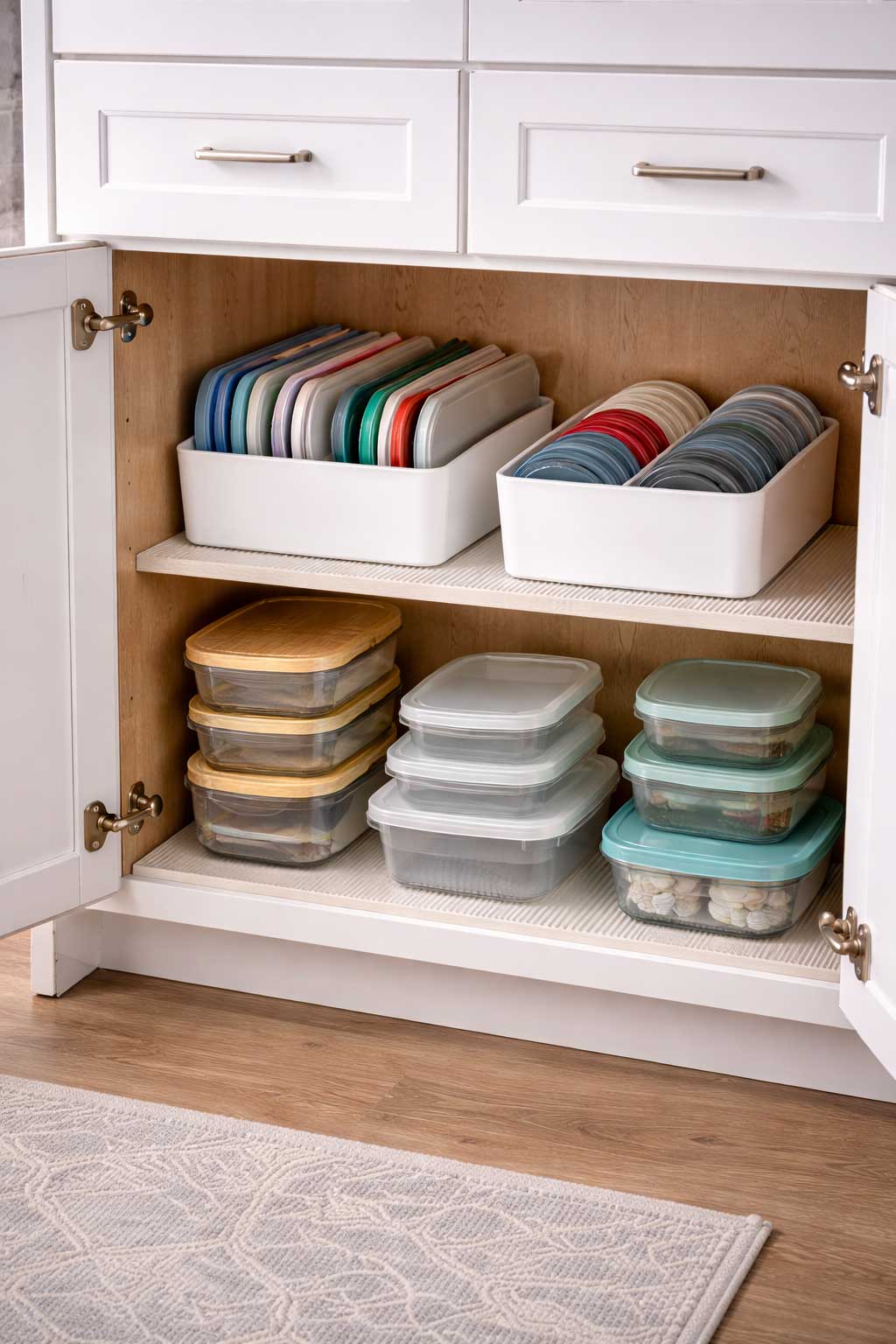
A better setup is to treat containers and lids as related but separate categories. Containers usually store best nested by size or shape. Lids usually store best upright in their own section, where they can be flipped through more like files than like a pile.
This change does two things. First, it makes the cabinet look more controlled. Second, it makes the containers much easier to use in real life. Instead of pulling down a whole tower and hoping the right lid is nearby, you can grab the base you need and find the lid much more quickly.
That kind of simplicity matters in a small kitchen, where one annoying cabinet can create more daily friction than almost any other storage problem.
Choose the Best Storage Type for Containers and Lids in a Small Kitchen
The best storage type depends on the layout of your cabinets and how large your container collection is.
Drawer dividers work especially well for lids if you have one wide enough drawer or a shallow cabinet shelf that can mimic drawer-like storage. They keep lids standing upright and prevent them from sliding into each other.
Bins are helpful for grouped lids, smaller containers, or categories like dressing cups and mini snack containers. These work well when the cabinet is deep and you need some internal structure.
Shelf risers can help if the cabinet height is being wasted. They create a second level and make it easier to separate different container sizes without stacking everything into one unstable tower.
Narrow organizers are especially useful for vertical lid storage. These can turn a chaotic lid pile into a simple grab-and-go section.
Deeper lower cabinets usually work best for the container bases themselves, especially if the pieces can nest cleanly. These cabinets often have enough depth for grouped stacks without crowding upper kitchen storage.
Pull-out or lower-cabinet setups make sense when the collection is larger and you need easier visibility. In many small kitchens, the lower cabinet becomes the main food-container zone because it is easier to access repeatedly throughout the week.
The key is choosing storage that fits the cabinet you already have instead of buying organizers first and hoping they work.
Best Container Storage Setups for Common Small Apartment Kitchen Layouts
If your kitchen has only a few lower cabinets, the best setup usually comes from giving one section fully to containers instead of trying to tuck them into several different spots. One defined zone usually works much better than scattering lids in one drawer and bases in another cabinet across the room.
If you have one deep, awkward cabinet, that cabinet can actually become a strong container zone if it has enough internal structure. Bins, risers, and vertical lid organizers can make a deep cabinet much more usable and keep pieces from disappearing into the back.
If your kitchen has very limited drawer space, lids usually need to live in a file-style section inside a cabinet rather than in a drawer. In that layout, the main goal is keeping them upright and easy to sort through.
If you live in a studio apartment where kitchen clutter stays highly visible, visual control matters more. A neat collection of nested containers and upright lids usually looks much calmer than a stuffed cabinet that is hard to open and impossible to reset cleanly.
Keep Lids Upright So They Stop Sliding Everywhere
Lids are usually the real reason this category feels chaotic. Containers can often stack or nest reasonably well. Lids rarely do. They slide, tilt, fall over, and create the kind of messy pile that makes the whole cabinet feel worse than it really is.
That is why upright lid storage makes such a difference. When lids stand vertically in a divider, narrow bin, or file-style section, they are easier to see and easier to sort through. They also stop creating that loose, collapsing pile effect that makes container storage so frustrating.
It also helps to group lids by size if possible. You do not need an overly complicated system, but larger lids and smaller lids usually work better when they are not all jammed together randomly. The more consistently the lids can stand and stay visible, the easier the whole container category becomes.
Nest Containers Without Creating an Unstable Tower
Nesting saves space, but too much stacking can make the collection harder to use. If the containers are piled into tall, wobbling towers, every time you need one piece the whole system starts to collapse.
A better approach is to nest by size and type while keeping the stacks short enough to handle easily. In many kitchens, that means one stack for smaller containers, one for medium, and one for larger pieces. If you have round and rectangular containers, separating those shapes often helps too.
This makes the cabinet easier to reset after dishwashing because each piece has a more obvious home. It also means you are less likely to shove random containers into the wrong stack just to get the cabinet closed.
If your lower cabinets need better internal structure for categories like this, explore Best Cabinet Storage Solutions for Small Apartments.
If food storage is also colliding with pantry items in the same area, revisit How to Organize Food Storage in a Small Apartment With No Pantry.
Use Cabinets and Drawers More Efficiently for Food-Storage Items
Container storage often improves not because you found more space, but because you made the existing cabinet space work better. A lot of small kitchens waste cabinet height, bury useful items behind awkward stacks, or let one category spread wider than it needs to.
This is where structure matters. Shelf risers help split vertical space. Bins help create zones. Dividers help keep lids standing. Under-shelf organizers can sometimes help create one more layer for lighter kitchen storage nearby, which keeps the container zone from competing with too many other categories.
The goal is not to pack the cabinet so tightly that nothing is easy to pull out. The goal is to make the cabinet more readable. When you can see the lids, reach the right stack, and put everything back without rearranging the whole shelf, the system is working.
If you need more flexible support inside kitchen cabinets, browse Best Under-Shelf Storage Baskets for Kitchens.
Mistakes to Avoid When Storing Reusable Containers and Lids
One common mistake is keeping too many mismatched pieces. This makes the whole category harder to manage than it needs to be. Another mistake is storing lids loose in the same pile as the containers, which usually creates the exact mess you are trying to fix.
Stacking containers too high is another problem. It may save space on paper, but in real use it often makes the cabinet more frustrating. Giving awkward low-use pieces prime cabinet space is another easy way to waste storage that should go to the items you reach for regularly.
Some kitchens also run into trouble by buying organizers that take up too much room relative to what they hold. A storage tool should help the collection fit better, not use more valuable cabinet space than the container mess itself.
Products That Make Container and Lid Storage Easier in a Small Apartment Kitchen
The best products are the ones that solve the specific problem your kitchen has. Some kitchens do best with one strong lid organizer and nested container stacks. Others need bins that create category boundaries in deep lower cabinets. In tighter layouts, shelf risers and more stack-friendly container sets make the biggest difference.
The right solution depends on the shape of your cabinets, how many pieces you truly need, and whether the bigger frustration is the lids, the bases, or both. In a small apartment kitchen, the best systems are usually the simplest ones. They make it easy to grab the right container, find the lid, and put everything back without a fight.
Final Thoughts on Storing Reusable Containers and Lids in a Small Apartment Kitchen
Reusable containers and lids are one of the easiest kitchen categories to lose control of, but they are also one of the easiest to improve once the system has some structure. That usually means keeping only the useful pieces, separating lids from bases, and making sure the cabinet supports the way you actually use leftovers and meal prep.
The strongest setups usually come from a few practical choices: nest containers by size, store lids upright, and make the whole category easy to reset after dishes are done. When those pieces come together, the cabinet feels calmer and the kitchen becomes easier to use.
The goal is not just to make the container cabinet look better. It is to make one of the most-used kitchen categories work better every day.
FAQ
How do you store food containers and lids in a small kitchen?
Store food containers and lids in a small kitchen by nesting containers by size, keeping lids in a separate upright organizer, and giving the whole category one defined storage zone.
What is the best way to organize reusable lids?
The best way to organize reusable lids is usually to store them upright in a divider, narrow bin, or file-style section so they stop sliding into a loose pile.
Should you store lids on or off food containers?
Lids usually store better off the containers because the bases can nest more efficiently and the lids are easier to sort and match when they have their own section.
How many reusable containers should you keep in a small apartment kitchen?
You should usually keep only the reusable containers you use regularly for leftovers, meal prep, and common food-storage needs, rather than every mismatched or awkward piece you own.
What storage works best for deep kitchen cabinets full of containers?
Deep kitchen cabinets usually work best with nested container stacks, bins, lid dividers, and other internal organizers that keep pieces grouped and prevent items from getting lost in the back.