How to Organize a Small Apartment Home Office
Working from home in a small apartment can feel either surprisingly efficient or constantly frustrating. The difference usually comes down to organization. When a home office area has a clear layout, the right storage, and a defined purpose, even a compact corner can feel productive and comfortable. When it does not, the space tends to become a clutter magnet full of cables, paper piles, chargers, notebooks, random supplies, and furniture that never really fit the room in the first place.
That is why organizing a small apartment home office matters so much. In a compact home, your office does not exist in isolation. It often shares space with a bedroom, living room, dining area, or even a hallway nook. If the office setup is messy, it can affect how the whole apartment feels. A cluttered desk makes the room look busier. A bad cable setup makes the space feel chaotic. Poor storage decisions can make the apartment feel like it is always halfway between work mode and clean-home mode.
The good news is that a small apartment office does not need a separate room to work well. It just needs more intention than a larger office might. In a compact space, every piece needs a reason to be there. The desk has to fit the footprint. The supplies need a defined home. The visible area has to stay controlled enough that work does not spill across the apartment. Once those things come together, a small office setup can feel much more polished and much less stressful.
This is one reason the topic fits so naturally with How to Maximize Storage in a Small Apartment, Best Office Desks for Small Apartments, and Best Minimalist Desk Setups for Small Apartments. In a small home, office organization is not just about work. It is about protecting the rest of the apartment from becoming part of the office by accident.
Why small apartment home offices get messy so quickly
Home offices tend to collect clutter faster than many other areas because they combine so many different categories in one place. A desk may need to support a laptop or monitor, chargers, notebooks, pens, papers, headphones, office tools, and sometimes personal items too. In a larger home, some of that overflow can spread into drawers, cabinets, or a separate office closet. In a small apartment, those same items often end up stacked on the desktop because there is nowhere else for them to go.
Another issue is that many apartment office setups are created quickly rather than planned carefully. A desk gets pushed into an available corner, a chair gets added, and then supplies gradually gather around it without any real system. That may work for a few days, but over time it usually turns into visual clutter and daily friction. If you need to move things around every time you sit down, or if papers and chargers are always drifting into other parts of the room, the setup is not really organized.
Small apartment offices also struggle because they often live in shared spaces. A desk in the bedroom or living room cannot afford to look like a full-blown office disaster area. When that work zone is messy, it changes how the entire room feels. That is why organizing the office is not just about productivity. It is also about making sure the apartment still feels like home when the workday ends.
Start with what the office actually needs to support
Before reorganizing anything, it helps to define what your home office is really being used for. Not every work-from-home setup needs the same kind of organization. Someone who works mostly on a laptop with a notebook and headphones needs something very different from someone who uses multiple monitors, paper files, writing tools, and office equipment every day.
The best office setups start by asking a few honest questions. Do you mostly need digital workspace, or do you constantly work with paper? Do you need a large surface, or do you mainly need a clean small surface with smart storage nearby? Are you taking calls, doing creative work, managing admin tasks, or switching between several types of work throughout the day? Are there supplies you reach for constantly, or do you only need a few basic items visible at once?
Once you understand what the desk area really needs to hold, it becomes much easier to organize it properly. A lot of office clutter comes from trying to prepare for every possible scenario instead of building around your real routine. In a small apartment, that difference matters. If your work is mostly digital, you probably do not need piles of visible paper supplies. If your job involves a lot of accessories, then storage near the desk becomes much more important than decorative styling.
A strong office setup is usually one that looks a little simpler than what people first imagine. In a small apartment, that is a strength, not a limitation.
The desk should fit the room, not dominate it
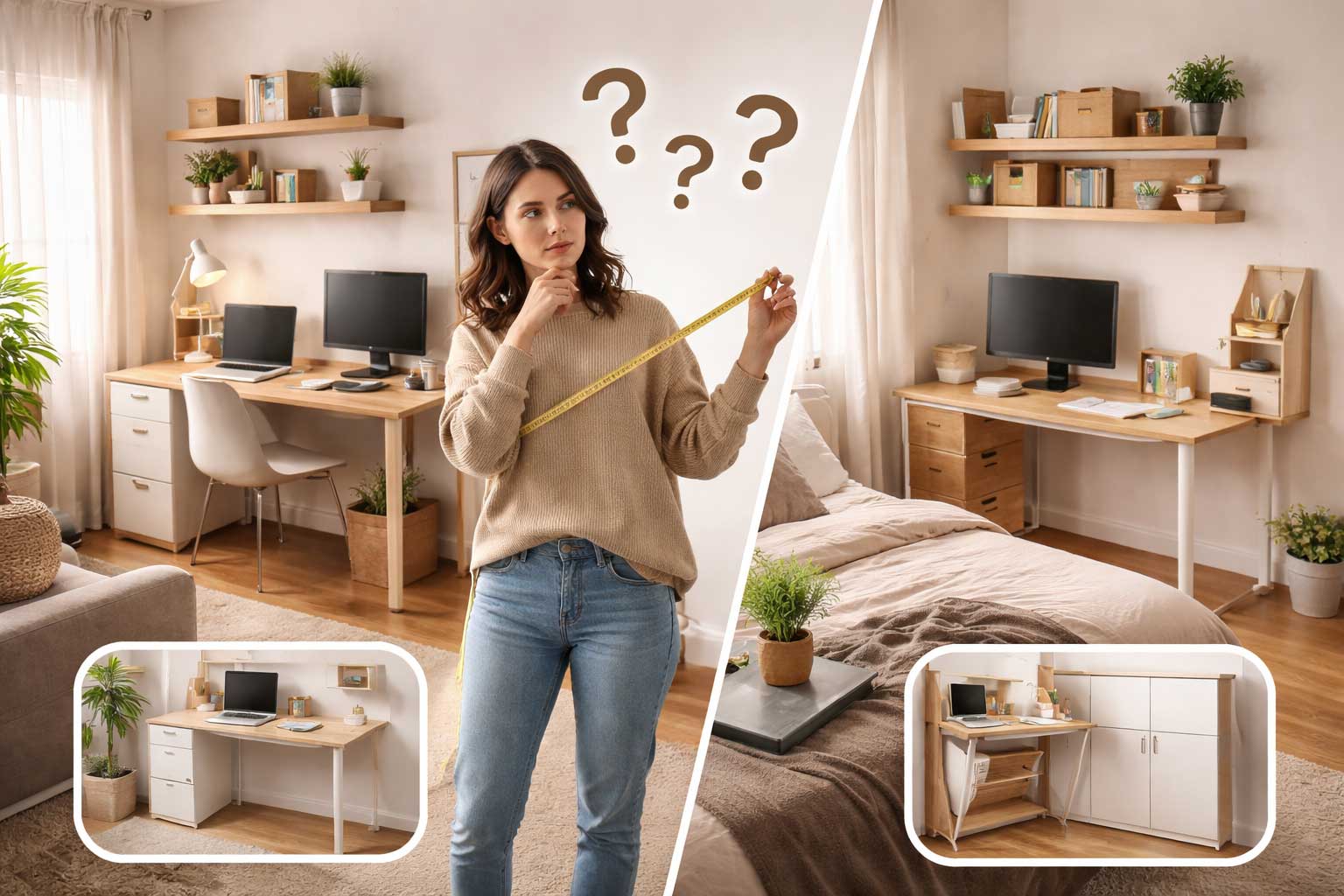
One of the biggest home-office mistakes in small apartments is choosing a desk as if the room were larger than it actually is. A desk can technically fit into a corner and still be too large for the apartment. If it interrupts movement, crowds nearby furniture, or visually takes over the room, it is not really a good fit.
That is why the desk should be chosen as part of the room, not just as a work surface. In a small apartment, the desk usually has to live alongside a bed, sofa, dining table, or storage furniture. It needs to support work without making the rest of the room feel compressed. Often that means choosing a narrower profile, a cleaner shape, or a desk that fits naturally against a wall instead of jutting too far into the room.
This is where Best Office Desks for Small Apartments and Best Foldable Desks for Small Apartment Offices become especially useful. In small-space living, the best desk is rarely the biggest one. It is the one that gives you enough function without demanding more visual and physical room than the apartment can comfortably spare.
A well-sized desk makes organization easier too. When the footprint is right, the room feels less stressed, and the office area starts to feel intentional instead of improvised.
Desktop clutter should be treated like a storage problem, not a personality trait
A lot of people assume messy desks are just part of how they work. Sometimes that is true to a degree, but in small apartments desktop clutter is usually a sign that the setup lacks structure. Pens, sticky notes, chargers, notebooks, and random small tools end up scattered across the surface because they do not have a defined home.
That is why organizing a small home office often starts with protecting the desktop itself. The desk should be a working surface first, not a long-term storage shelf. If every inch is covered by accessories and supplies, the space becomes harder to use and more visually exhausting. In a small apartment, that kind of visual overload spreads into the rest of the room too.
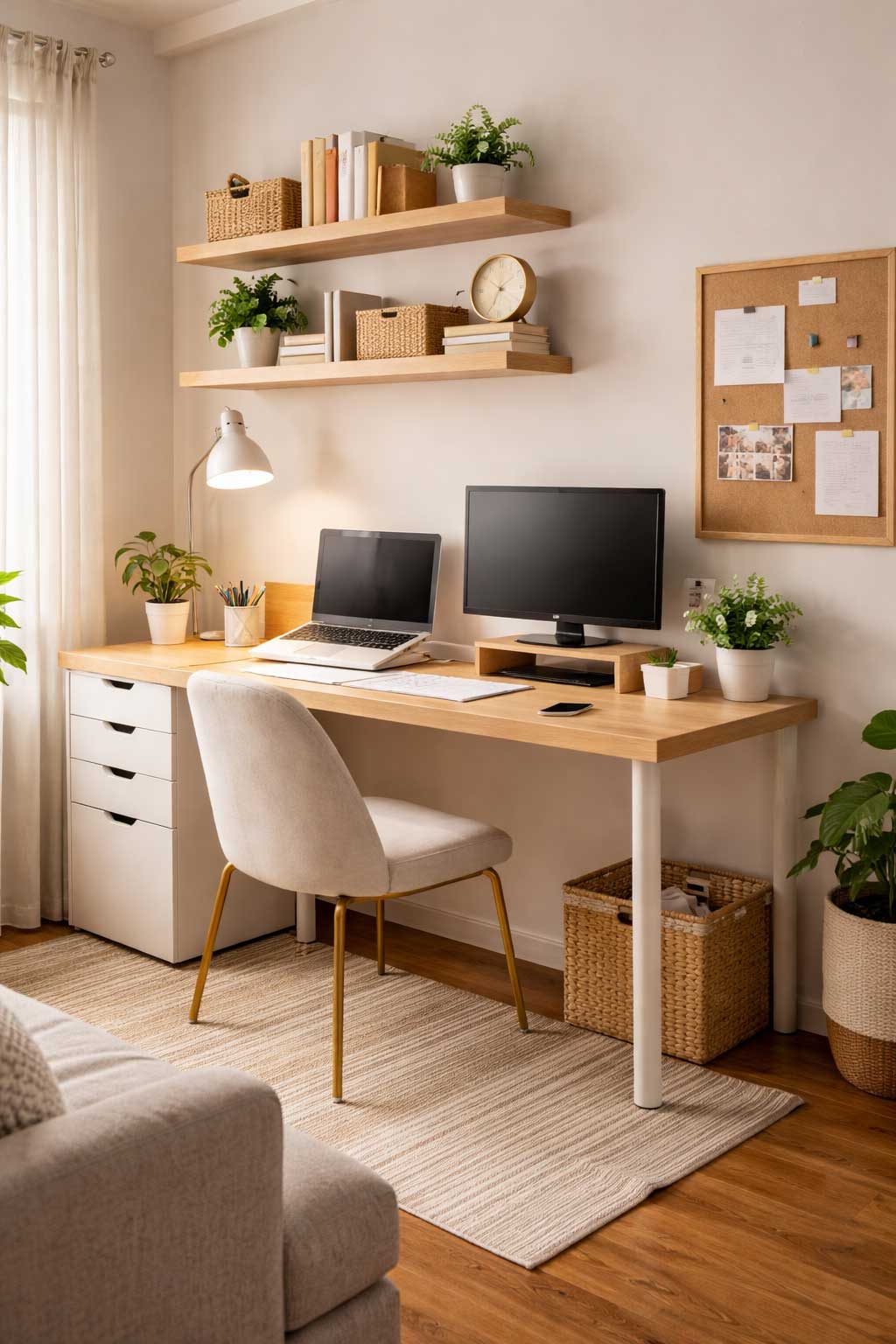
The goal is not to make the desk look sterile. It is to make sure only active-use items stay on the surface. Your computer, one notebook, maybe a lamp, and a limited number of frequently used supplies may deserve to stay out. Everything else should either be stored nearby or edited out of the setup entirely.
This is one reason Best Desk Organizers for Small Apartment Offices and Best Desk Drawer Organizers for Small Apartment Offices can support this topic so well. They help contain the categories that otherwise end up floating all over the work surface. When the desktop becomes more intentional, the whole office instantly feels calmer.
Vertical storage usually matters more than floor storage
Small apartment offices often run out of horizontal space very quickly, which is why vertical storage is usually more useful than adding more furniture on the floor. A compact office area works better when it builds upward rather than outward. That may mean shelving above the desk, wall-mounted organizers, or storage that uses height without increasing the footprint too much.
This approach matters because office clutter is often made up of medium-size items that do not need constant access but still need a home. Notebooks, supplies, files, books, and tech accessories often do much better on shelves or in controlled vertical storage than spread across the desk or stacked around the room. Once those categories move upward, the office tends to feel much more manageable.
That is why Best Floating Shelves for Small Apartment Offices can be such a strong companion page here. Floating shelves let the office gain storage without asking for more floor area, which is exactly what a small apartment needs. They can also help define the office zone visually, especially if the desk is sitting inside a bedroom or living room rather than in its own dedicated room.
Vertical storage works especially well in apartments because it helps the office feel contained. Instead of office supplies bleeding out into the rest of the room, they stay anchored to one intentional area.
Cables can make an organized office feel messy
Even when a desk is relatively clean, visible cords can make the whole setup feel chaotic. Charging cables, monitor cords, power strips, laptop adapters, and accessory wires tend to create visual clutter much faster than people expect. In a small apartment, that cable mess is even more noticeable because the office is often out in the open rather than hidden in a separate room.
That is why cable control is one of the most important parts of organizing a small home office. A workspace with decent storage but messy cables rarely feels truly organized. Wires running across the desk, hanging behind the table, or collecting around the floor can make even a nice setup look improvised and harder to maintain.
This is exactly where Best Cable Management Kits for Small Apartment Offices becomes highly relevant. When the cable setup is cleaner, the whole office feels more polished. It also makes cleaning easier and keeps the room from feeling like a temporary workstation that never really found its place in the apartment.
Good cable organization is one of those upgrades that does not sound exciting until it is done. Then it becomes one of the most noticeable improvements in the entire setup.
Monitor height and desk ergonomics affect organization too
Office organization is not only about storage. It is also about how the workspace feels to use. If your monitor sits too low, your laptop takes up the whole desk, or your keyboard and accessories never seem to fit comfortably, the problem may not be clutter alone. It may be that the desk is not supporting the work well enough.
That is why ergonomics matter here. A desk that feels physically uncomfortable often becomes harder to keep organized because everything on it is fighting for usable space. If the screen placement is awkward, accessories get moved around constantly. If the desk surface is swallowed by devices, there is less room for anything else to stay controlled.
This is where Best Monitor Stands for Small Apartment Desks can support the setup especially well. A raised monitor can free up space beneath it, improve how the desk functions, and make the whole workspace feel less cramped. In a small apartment, those little gains matter because every bit of usable surface counts.
A home office is much easier to keep organized when the basic working position makes sense. Comfort and organization usually help each other more than people realize.
The office zone should feel separate even if it shares a room
Many apartment home offices live inside a bedroom, living room, or multipurpose corner. That means the office area needs some kind of identity without feeling like it takes over the room. When that balance is missing, the apartment can feel like it is always half office and half living space, which makes it harder to relax after work.
Organization plays a huge role in that separation. A clearly defined work zone with a contained desk, controlled supplies, and clean boundaries feels more manageable than a setup that spreads into nearby surfaces. Even if the office shares a room, it should still feel like one specific area with one specific purpose.
This is one reason Best Minimalist Desk Setups for Small Apartments is such a natural internal link for the topic. Minimalist does not have to mean empty or cold. In this context, it means a setup where the work essentials are clear, the extras are controlled, and the office does not visually bleed into the rest of the room more than necessary.
In a small apartment, that kind of boundary is what keeps the workspace from making the whole home feel busier than it needs to.
Storage near the desk should support the routine, not just hold stuff
A lot of office storage fails because it is too generic. A basket of random supplies, a cabinet full of unsorted paper, or a drawer packed with unrelated office items may technically hold things, but it does not really support the workday. Good office storage should make it easier to reach what you need and easier to put it away again.
That usually means organizing around your actual routine. Items you use every day should be closest. Items you use weekly can sit nearby but not necessarily on the desk. Rarely used items can be stored lower, higher, or farther out of immediate reach. Once storage follows that logic, the office becomes much easier to maintain because you are no longer treating every item like it deserves prime space.
This is where Best Under-Desk Storage Drawers for Small Offices can be especially helpful. Under-desk storage often works well in apartments because it keeps useful items close without adding another bulky piece of furniture nearby. It is one of the cleanest ways to give the desk support without making the room feel heavier.
The best office storage is not just organized. It is convenient in the right way.
Small home offices benefit from editing more than expanding
When an apartment office feels cluttered, the first instinct is often to add more storage products. Sometimes that helps, but often the better first move is to reduce what the office is trying to hold. Small spaces usually improve more from editing than from endless expansion.
That means being selective about what really belongs there. If paper piles are outdated, if duplicate supplies keep accumulating, or if old tech accessories are hanging around with no defined use, those things are taking up space the office can no longer afford to waste. A cleaner office is not always the result of more organizers. Sometimes it is just the result of fewer unnecessary categories.
This is why How to Maximize Storage in a Small Apartment remains such a useful companion to the office topic. Small apartments work best when every zone holds what it actually needs and not much more. The office should be no exception. If the setup feels crowded, it is worth asking whether the issue is really lack of storage or just too much being asked of one small area.
Editing makes the office feel more intentional. In a compact home, that often matters more than adding another shelf or container.
A well-organized home office should make it easier to stop working too
That is one of the most underrated goals. People usually think about office organization in terms of productivity, and that matters, but in a small apartment it also matters that the office can shut down cleanly. If work items stay scattered across the desk, nearby furniture, and surrounding room, it becomes harder for the apartment to feel off-duty when the day is over.
A strong office setup makes it easier to close the laptop, reset the space, and let the room return to its non-work identity. That might mean a desktop that clears quickly, supplies that go back into drawers easily, or a cable setup that does not leave the entire corner looking tangled and half-finished. In a small home, that transition matters more because there is less physical separation between work life and the rest of life.
That is why organizing the office is about more than appearances. It is about making the apartment feel easier to live in. A well-organized office helps you focus while you are working and helps you mentally step away once the workday is done.