How to Use Open Shelving in a Small Living Room Without Visual Clutter
Open shelving can be a great way to add storage and style to a small living room, but it can also become one of the fastest ways to create visual clutter. In many apartments, shelves end up holding a mix of books, baskets, candles, framed art, and random overflow that does not have a better home. When too much ends up on open shelves, the living room can start to feel busier and smaller even if the storage itself is technically helpful.
The good news is that open shelving can work very well in a small living room when it is used with more intention. The key is to keep shelves edited, use them for the right categories, and treat them as part of the room’s overall layout instead of as a place to display everything at once. With the right setup, open shelving can add useful storage and visual interest without making the room feel crowded.
For wall-based shelf ideas, start with Best Floating Shelves for Small Living Rooms.
If you want TV-area shelving that stays more functional, check out Best Wall-Mounted Media Shelves for Small Living Rooms.
This guide is part of our Small Apartment Living Room Solutions collection.
Why Open Shelving Can Feel Cluttered So Fast in a Small Living Room
Open shelving creates visual clutter faster than closed storage because everything stays in view all the time. A cabinet can hide mixed categories, loose items, and imperfect organization behind a door. A shelf does the opposite. Every object becomes part of the room’s visual design whether you meant it to or not. In a small living room, that makes shelf decisions much more noticeable.
This matters even more in apartments because compact rooms usually have less visual breathing room to begin with. The sofa, coffee table, TV, lamps, and decor already create enough presence. When shelves add too many objects on top of that, the room can start feeling full very quickly. Even useful items like baskets, books, and framed pieces can make the space feel busy when too many are competing for attention at once.
Mixed categories are another major problem. A shelf with books, remotes, candles, chargers, paperwork, and decorative objects all together rarely feels calm. The best open shelving usually feels lighter because it has a clearer purpose. In a small living room, clarity matters as much as storage.
Start by Deciding What Actually Belongs on Open Shelves
The first step is deciding what kinds of items deserve to stay visible. Open shelving is not the right place for every category of living room storage, and a lot of clutter problems start when shelves are asked to hold too much of the wrong stuff.
Decorative items, a small number of books, and a few edited everyday pieces usually work best. These are categories that can look intentional when displayed. Messier items usually need closed storage instead. Chargers, extra remotes, scattered papers, miscellaneous cords, and general apartment overflow almost always look better behind a door or inside a basket rather than out on full display. If your room needs better concealed support nearby, browse Best Compact Accent Cabinets for Living Rooms.
It also helps to limit the number of categories on each shelf. A shelf usually looks cleaner when it holds fewer types of items instead of trying to do everything at once. In a small living room, that restraint is what keeps the storage from turning into visual noise.
Keep the Shelf Layout More Edited Than Full
One of the biggest mistakes with open shelving is trying to maximize every inch of storage. That instinct makes sense in a small apartment, but with open shelves it often backfires. A shelf that is packed full rarely looks organized, even if everything technically fits.
Negative space is what makes shelving feel lighter. A little open area between objects helps the eye rest and keeps the room from feeling visually overworked. That is especially important in a small living room where the shelves are often visible from most angles in the room. A few grouped objects usually look more intentional than lots of scattered smaller pieces.
This is also why slimmer shelving options usually work better than very heavy ones. If you want alternatives that still keep the room feeling vertical and light, take a look at Best Slim Living Room Bookshelves for Apartments. In a compact room, shelves do not need to be full to be useful. They need to feel controlled.
Use Baskets, Books, and Decor More Intentionally
A lot of the items people naturally place on shelves are not bad choices. The problem is usually how they are combined. Baskets, books, and decor can all help a shelf look styled, but they need more intention in a small living room than they would in a larger room.
Baskets can be especially useful because they hide smaller clutter without forcing everything into closed furniture. But they work best when used sparingly and when they fit the scale of the shelf. One or two matching baskets often look much better than several mixed bins crammed into every open spot.
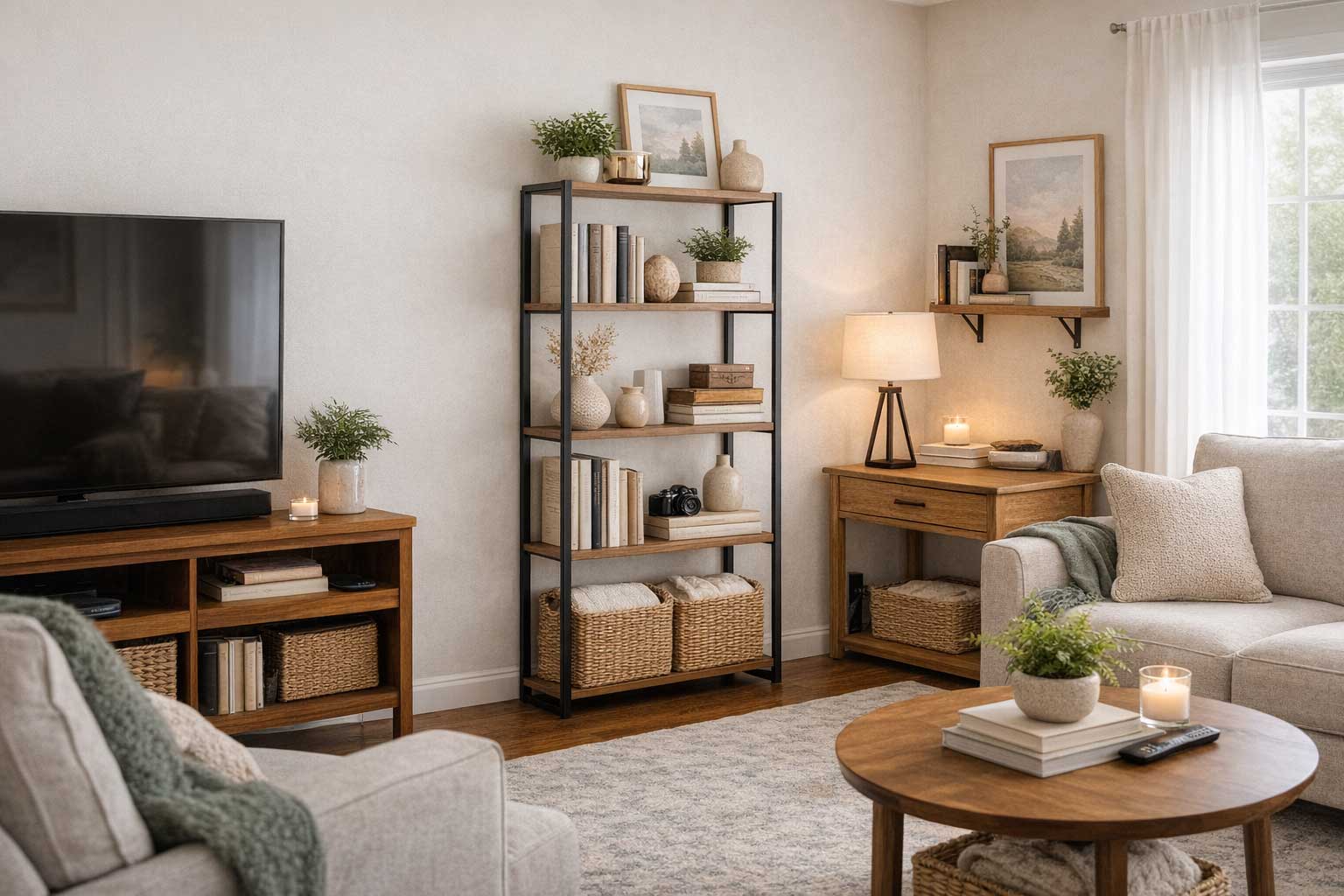
Books also look better when they feel grouped with purpose. A small stack, a short upright row, or a balanced mix of the two usually feels cleaner than a shelf with books scattered randomly across multiple zones. Decor should add texture and shape, not overwhelm the shelf. A plant, frame, candle, or sculptural object can help the shelf feel complete, but only when those pieces are not competing with too many other categories at once.
Make the TV Wall Shelves Feel Functional, Not Overloaded
The TV wall is one of the most common places open shelving appears in a small living room, and it is also one of the easiest places to overdo it. Because the television is already a strong focal point, everything around it needs a little more restraint.
Wall-mounted media shelves can work well when they support the area instead of crowding it. That might mean holding a few books, one small basket, or a couple of controlled decorative pieces rather than trying to turn the TV wall into a full display zone. If your entertainment area needs better vertical support, see Best Wall-Mounted Media Shelves for Small Living Rooms.
It also helps to let hidden storage handle the messier media categories. Electronics, extra cables, remotes, and smaller devices usually do better when they are tucked away instead of competing with decor on open shelves. For cleaner TV-area support, browse Best Hidden Media Storage for Small Apartments.
The TV wall usually looks better when it has fewer shelf items, not more. In a small living room, that kind of restraint makes the whole entertainment zone feel calmer.
Use Open Shelving to Support the Room Instead of Dominating It
Open shelving should feel like part of the room, not the main event. That usually comes down to proportion. Shelf size should relate to the furniture below it and to the wall itself. Oversized shelves on a narrow wall, or too many stacked shelves above a small media console, can make the whole room feel top-heavy.
A few well-placed shelves usually work better than covering the wall with storage. The room feels more open when shelving is selective. This is especially true in apartment living rooms where the wall area is often shared visually with art, lighting, and the TV. Too many shelf elements can make the room look fragmented instead of cohesive.
Support furniture matters too. A narrow console or lighter furniture below the shelves often helps the entire setup feel more balanced. If you need a slimmer supporting piece beneath or beside a shelving wall, check out Best Narrow Console Tables for Small Living Rooms. Good shelving helps the room feel taller and more finished. Bad shelving makes it feel crowded from the top down.
Keep Everyday Living Room Clutter Off Display
One of the biggest differences between open shelving that looks styled and open shelving that looks messy is whether everyday clutter has somewhere else to go. Open shelves work best when the room already has hidden storage nearby for the categories that should not stay visible.
Remotes, cords, extra chargers, paperwork, random household overflow, and all the small things that build up during normal life usually do not belong on display. If those items do not have another home, they eventually drift onto the shelves because the shelves are available. That is when open storage starts working against the room instead of helping it.
Closed storage nearby makes all of this easier. A cabinet, storage bench, or hidden media piece can absorb the messy categories so the shelves can stay lighter and more attractive. If you need better nearby support for those less-display-friendly items, take a look at Best Living Room Storage Benches for Small Apartments. Cleaner open shelves usually depend on stronger hidden storage somewhere else in the room.
Make Open Shelves Feel Styled Without Looking Overdecorated
There is a difference between styled and overdecorated, and small living rooms feel that difference quickly. A shelf can look thoughtful without being packed with accessories. In fact, the most polished shelves often feel simpler than people expect.
Repeating materials helps. If the room already uses warm wood, black metal, woven accents, or neutral ceramics, bringing a few of those same elements onto the shelves creates cohesion. Color restraint helps too. When shelf items stay within a more controlled palette, the room usually feels calmer and more spacious.
The shelf should support the room, not steal all the attention. In a small living room, shelving works best when it feels like part of the overall design rather than a separate decorating project happening on the wall. A few edited pieces almost always create a better result than trying to fill every shelf with “interesting” items.
Common Mistakes That Make Open Shelving Look More Cluttered
One common mistake is using shelves as overflow storage for everything that does not have a better place. That almost always leads to mixed categories and visual clutter. Another mistake is displaying too many small objects at once. Small items multiply visual noise faster than people expect, especially in compact rooms.
Mixing too many materials, colors, or categories can also make shelves feel chaotic. Even good objects start fighting each other when there is no visual discipline holding them together. Installing more shelves than the wall needs is another major issue. Just because a wall can fit more shelving does not mean it should.
The best open shelving usually succeeds because it is selective. It holds enough to be useful, but not so much that it starts making the whole living room feel busier.
Best Features to Look for in Open Shelving for Small Living Rooms
When choosing open shelving for a small living room, slim depth should be one of the first things you look for. Shallower shelves usually feel lighter and work better visually in apartment layouts. A clean, apartment-friendly design also matters because the shelves will almost always stay in view.
Strong but lighter visual presence is another good trait. Shelving should feel substantial enough to be useful without becoming heavy-looking. Flexible styling potential helps too. The best shelves can hold books, baskets, or decor in different combinations without looking awkward.
Easy access also matters. Shelves should help the room function better, not become so decorative that you cannot use them comfortably. In a small living room, the best open shelving is practical enough to support daily life but restrained enough to keep the room feeling calm.
Final Thoughts on Using Open Shelving in a Small Living Room Without Visual Clutter
Open shelving can work beautifully in a small living room, but it needs more discipline than closed storage. The best setups stay edited, balanced, and supported by hidden storage elsewhere so the shelves do not turn into a visible holding area for every extra item in the room.
A few thoughtful shelves, a controlled mix of books and decor, and better nearby closed storage usually create a much stronger result than trying to use open shelving as a full storage substitute. In a small apartment, the room feels better when the shelves stay light enough to support the space instead of weighing it down.
The goal is not to make the shelves empty. It is to make them intentional. When open shelving is styled with restraint and supported by better hidden storage, it adds function and character without making the living room feel crowded.
Our Top Open Shelving Picks for Small Living Rooms
Open shelving works best in a small living room when it adds vertical storage and style without becoming a display zone for clutter. The most useful options usually stay slim, visually light, and easy to style in a controlled way.
Best overall choice:
Floating shelf — A slim floating shelf adds storage and display space without the bulk of floor furniture.
👉 Check price on Amazon
Best TV-wall option:
Wall-mounted media shelf — A media shelf helps support the entertainment area without crowding the floor or overloading the room.
👉 Check price on Amazon
Best vertical alternative:
Slim living room bookshelf — A narrow bookshelf can provide more storage while still feeling lighter than wider shelving furniture.
👉 Check price on Amazon
Best clutter-control support piece:
Compact accent cabinet — A small accent cabinet helps keep messier categories hidden so open shelves can stay edited and attractive.
👉 Check price on Amazon
Living rooms that need a little more hidden support may also benefit from a storage bench or media console, especially when the goal is to keep open shelving looking styled instead of overloaded.
FAQ
How do you use open shelving without clutter?
The best way to use open shelving without clutter is to keep the shelves edited, limit the number of categories displayed, and rely on nearby closed storage for messier everyday items.
What should go on open shelves in a small living room?
Open shelves in a small living room usually work best with a controlled mix of books, baskets, framed art, plants, and a small number of decorative objects.
Are open shelves good for small living rooms?
Yes, open shelves can be great for small living rooms when they stay lightly styled, are scaled well to the room, and are supported by hidden storage elsewhere.
How do you style shelves without making a room look busy?
Style shelves without making a room look busy by using fewer objects, repeating materials or colors, leaving negative space, and avoiding too many mixed categories on the same shelf.