How to Hide Cords and Cable Clutter in a Small Apartment
Cords and cable clutter can make a small apartment feel messier than it actually is. Even when the furniture looks good and the surfaces are mostly clean, a tangle of charging cables, power strips, TV wires, desk cords, lamp cords, and random adapters can make the whole space feel unfinished. In a compact apartment, that effect is even stronger because there is less room to visually absorb the mess. A few visible cables in the wrong places can make a bedroom, living room, or home office feel more chaotic than it really is.
That is why hiding cords matters so much in a small space. It is not just about aesthetics. Cable clutter affects how organized the apartment feels, how easy it is to clean, and how intentional the room looks overall. If cords are running across the floor, dangling behind furniture, or collecting around outlets, the room starts feeling improvised instead of settled. In a small home, where furniture often needs to multitask and every corner matters, that kind of visual noise builds up quickly.
The good news is that cable clutter is usually one of the easier apartment problems to improve once you decide to handle it intentionally. Most small apartments do not need a dramatic tech makeover. They just need better cable boundaries. Once chargers, extension cords, power strips, and loose wires are grouped more thoughtfully, the apartment often looks calmer almost immediately. The room does not have to be perfectly minimal to feel better. It just needs fewer visible tangles and fewer cords drifting wherever they happen to land.
This topic fits naturally with How to Organize a Small Apartment Home Office, Best Cable Management Kits for Small Apartment Offices, and Best Minimalist Desk Setups for Small Apartments because cable clutter is one of the biggest reasons a workspace or media area stops feeling organized. In a small apartment, managing cords well is one of the fastest ways to make a setup feel more polished.
Why cable clutter feels worse in a small apartment
In a larger home, cables can disappear more easily. There may be more furniture, more room behind media consoles, more space under desks, and more distance between outlets and the main living areas. In a small apartment, wires are usually much more visible. The TV may sit only a few feet from the sofa. The desk may be part of the bedroom or living room. Charging stations may have to share space with daily-use surfaces. That means cables do not just exist in the background. They become part of the room’s visible design whether you want them to or not.
Another reason cable clutter stands out is that cords rarely look like one tidy category. They usually appear as visual leftovers. A phone charger runs across the side table. A lamp cord trails behind the sofa. A router cable hangs below the media console. Extra adapters collect near the desk. Nothing matches, and nothing looks intentional. In a small apartment, that scattered effect can make the room feel less finished even when everything else is relatively neat.
Cable clutter also tends to create practical frustration. It makes vacuuming and sweeping more annoying. It can make furniture harder to move. It often causes people to pile things near outlets or leave chargers plugged in permanently because the setup feels too messy to manage any other way. Once that starts happening, the room becomes harder to reset at the end of the day.
That is why cords should be treated like a real organization issue, not just a cosmetic annoyance. In a compact apartment, cable management is part of keeping the whole space under control.
Most cable problems come from too many undefined zones
A lot of cord clutter is really a zone problem. The apartment may have charging happening in too many random places. Devices may be plugged in wherever there is an outlet instead of where the room actually supports them best. A laptop charger drifts from the desk to the couch. A phone charger ends up by the bed, then another appears in the living room, then another lives at the kitchen counter. Over time, the apartment starts collecting cables in a scattered way because nothing has been assigned a real home.
That is why the first step is not always buying cable products. Sometimes it is deciding where certain tech routines should actually happen. If your work devices belong at the desk, then that area should become the main charging and cable zone for those items. If the bedroom only needs a simple overnight phone setup, that area should stay minimal. If the living room has a TV, gaming system, or soundbar, then that should be a contained media zone rather than a cluster of wires spreading outward.
Once the apartment has clearer tech zones, cable control becomes much easier. You stop asking every outlet in the apartment to solve every problem. In a small space, that kind of clarity matters because random overflow becomes visible so quickly. Defined zones keep cords from expanding into every room just because it is convenient in the moment.
Start by identifying your worst cable-clutter areas
The easiest way to improve cable mess is to look for the places where it bothers you most right now. In most apartments, the worst spots are usually very predictable. The desk area is often one. The TV console is another. Bedside charging zones are common problem areas too. In some apartments, the kitchen counter or entry table also becomes a temporary charging area that slowly turns into permanent clutter.
These problem zones matter because they are where the biggest improvements usually happen first. You do not need to solve every cable in the apartment all at once. If the desk looks messy every day, start there. If the media setup is what makes the living room feel chaotic, start there. If the bedroom nightstand is always buried in charging cables, start there. Most small apartments will feel significantly better once the main visible tangles are under control.
This is also where How to Organize a Small Apartment Home Office becomes especially relevant. Desk cable clutter is often one of the biggest reasons a workspace looks more stressful than it should. When the main work zone feels cleaner, the entire apartment usually benefits because that office area is often visible from the rest of the room.
The key is to choose the most irritating cable area first and make it feel intentional. Once one zone improves, it becomes easier to apply the same logic elsewhere.
Desk cables usually need the most attention
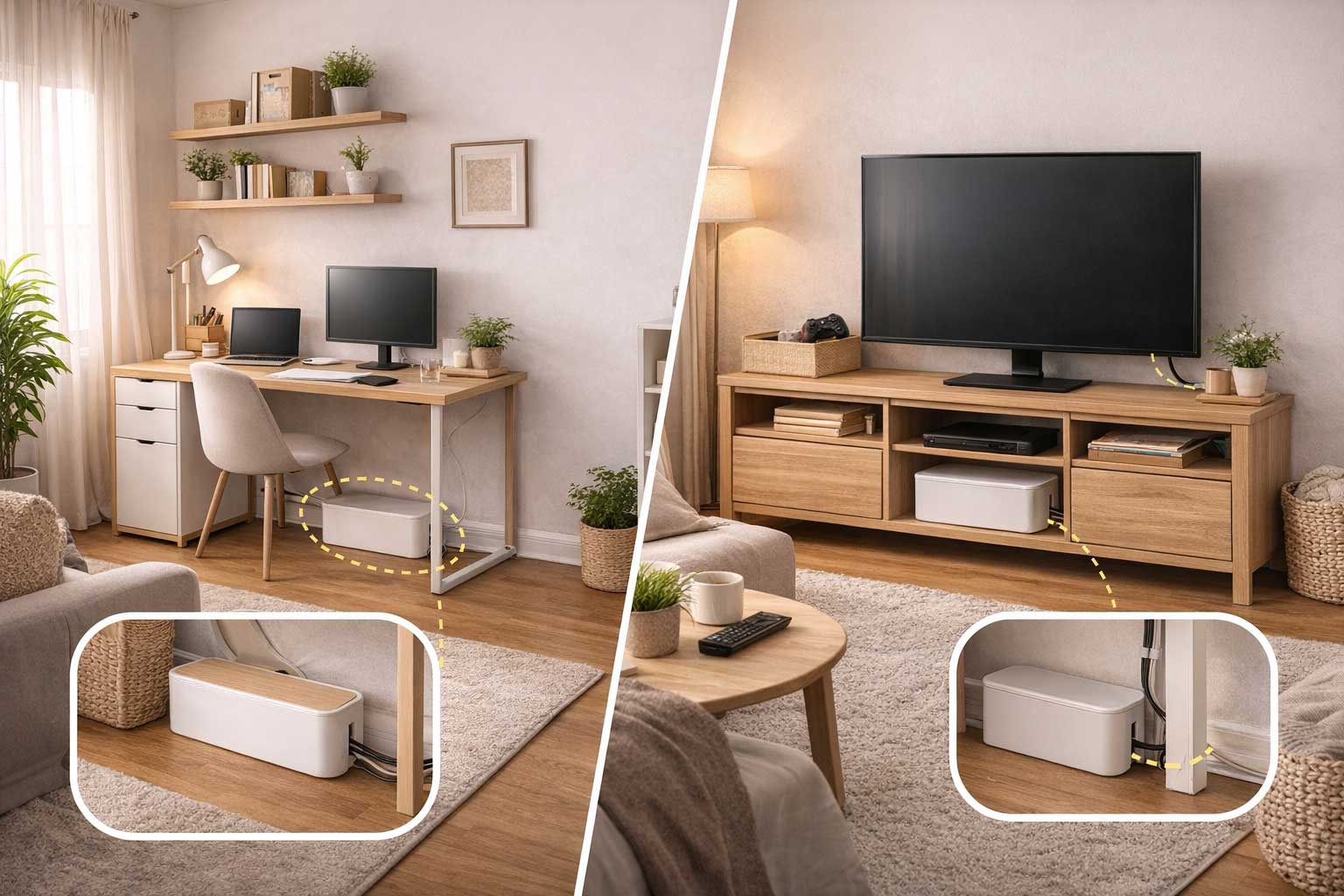
For many people, the desk is where cable clutter gets out of control fastest. Laptops, monitors, chargers, desk lamps, keyboards, speakers, printers, headphones, and phone chargers all compete for the same outlet area. Without a plan, that quickly turns into a mess of visible wires under the desk, behind the monitor, and across the work surface.
That is why desk cable management usually deserves more thought than other parts of the apartment. A clean desk setup is not just about the desktop itself. It is also about what is happening around and underneath it. If the cable mess is bad enough, even a well-organized desk can still look chaotic. The office zone ends up feeling like a temporary setup instead of a contained work area.
This is exactly where Best Cable Management Kits for Small Apartment Offices, Best Monitor Stands for Small Apartment Desks, and Best Desk Organizers for Small Apartment Offices can support the problem well. Monitor stands can create more defined space for devices and cables, desk organizers can prevent charging accessories from drifting all over the surface, and cable kits can help group or route the wires more cleanly. In a small apartment, these details matter because the office often sits right in the middle of everyday living space.
A desk should not look like every device is fighting for survival. It should look like the tech belongs there and has been given a plan.
TV and media cords can make the whole living room feel messy
Cable clutter around the television tends to have a bigger visual impact than people expect. Even a nice media console can look disorganized if wires are hanging behind it, pooling underneath it, or stretching awkwardly toward nearby outlets. Since the TV area is often one of the visual anchors of the living room, messy cables there can make the whole room feel less polished.
This is especially noticeable in small apartments where the TV wall or media console is not far from the sofa, dining table, or entry area. Cables that would disappear more easily in a bigger house are much more visible when the room is compact. A cluster of streaming-device cords, router cables, gaming-system wires, and extension strips can make the entire room feel more improvised.
That is one reason media cable management matters so much. It is not just about the electronics. It is about protecting the visual calm of the living room. In many apartments, the media setup needs more concealment than people first realize. If cords are left loose, they become part of the room’s design whether you intended that or not.
This is where Best Cable Boxes for Small Apartment Offices can still be surprisingly relevant, even outside the office zone. A cable box or similar concealment solution can help keep power strips and excess cord length from becoming floor-level clutter in any room, especially the living room.
Bedside cords should be kept simpler than most people think
Bedrooms often collect more cables than they really need. Phone chargers, smart-watch chargers, tablet cords, lamp cords, and sometimes sound machine or reading-light cords all end up fighting for space around a narrow nightstand. In a small apartment bedroom, that quickly makes the bedside area feel cluttered, especially when there is already limited surface space near the bed.
The best way to improve this is usually not to build a giant bedside charging station. It is to simplify. Most small bedrooms feel better when the bedside zone only supports the devices and lighting that truly belong there every night. If too many chargers are permanently crowding the area, the room starts feeling more like a tech corner than a place to rest.
That is part of why cable clutter has such a strong emotional effect in bedrooms. The mess is not just visual. It works against the calm the room is supposed to provide. When the bedside area is simplified, the bedroom often feels more restful right away.
This connects naturally with How to Choose Bedroom Lighting for a Small Space, because lamp placement and charging clutter often overlap. A better lighting plan can sometimes reduce bedside cord mess simply by creating a cleaner, more intentional setup.
Furniture placement affects how easy cords are to hide
One of the reasons cable clutter gets so annoying is that furniture is often arranged without thinking much about outlets. Then, once the room is set, cords have to stretch awkwardly to reach where they need to go. That may be unavoidable sometimes, especially in rentals, but it is still worth paying attention to. A small adjustment in furniture placement can often reduce a lot of cable frustration.
This is especially true with desks, media consoles, and side tables. If a desk sits too far from an outlet, the cable setup may automatically become more visible. If the TV console is centered in a way that leaves all the wires exposed off to one side, the whole room may feel messier than necessary. In a compact apartment, even small shifts can make cable concealment much easier.
That is why cable control is partly a layout issue. It is not always just about buying the right accessories. Sometimes it is about giving the cords a shorter, more logical path. When furniture placement supports that, the apartment immediately becomes easier to keep looking organized.
The goal is not zero cords. It is fewer visible cords
One reason people avoid dealing with cable clutter is that they imagine the goal has to be perfection. It does not. In a real apartment, especially one with work devices, lamps, and media equipment, there will always be some cords. The real goal is not to pretend the apartment uses no electricity. It is to reduce the number of cords that are actively visible and visually disruptive.
That distinction matters because it makes the task more realistic. You do not need an invisible, magazine-perfect setup to make the apartment feel dramatically better. You just need the obvious tangles gone, the worst draping wires controlled, and the charging areas more contained. Once the eye stops catching on random cable mess, the room starts feeling much cleaner.
This is one reason cable management has such a good return for the effort. A relatively small improvement can create a disproportionately strong effect. If you hide one power strip, contain one charging area, and clean up one desk setup, the room often looks much more finished even though you have not changed much else.
For a small apartment, that kind of improvement is worth a lot.
Hiding cables works best when the rest of the setup is simplified too
Cable clutter is often tied to general setup clutter. If the desk holds too many gadgets, the cords will probably stay messy. If the TV area has too many accessories piled around it, the wires will feel worse too. That is why cable cleanup works best when it is part of a broader simplification effort.
A cleaner, more restrained setup is always easier to wire well. Fewer visible accessories usually means fewer visual interruptions. More defined tech zones usually mean fewer duplicate chargers drifting across the apartment. Better storage for small devices usually means fewer cords casually living on top of furniture. Once the setup itself becomes more selective, cable management gets much easier to maintain.
This is another place where Best Minimalist Desk Setups for Small Apartments becomes such a useful internal link. Minimalist in this context does not mean empty. It means the setup is edited enough that the cables no longer have to support chaos. A cleaner system naturally leads to cleaner cord management.
In a small apartment, the best-looking cable solutions usually come from simplifying the setup, not just hiding the mess more cleverly.
Good cable management makes cleaning easier too
One of the biggest practical benefits of hiding cords is that it makes the apartment easier to clean. Loose wires collect dust, trap debris, and create little obstacles around desks, media consoles, and side tables. Vacuuming around a cable nest is always more annoying than it should be. Sweeping around power strips on the floor rarely feels worth the effort, so mess builds up underneath and around them.
When cables are grouped better and lifted out of the way where possible, the room becomes easier to maintain. That may not sound glamorous, but in a small apartment it matters a lot. The easier the room is to clean, the more likely it is to stay feeling controlled. Even a nice-looking cable setup is not really helping enough if it still creates a pain every time you vacuum.
That is another reason cable clutter should be treated as part of organization rather than just décor. It affects how the apartment functions. A cleaner floor, cleaner desk area, and cleaner media zone all make the home easier to live in.
The best cable setup is the one you will actually maintain
At the end of the day, the goal is not to create a one-time visual fix. The goal is to build a cable system that stays better over time. That means your most-used chargers should be easy to reach without turning into tangles again. The desk setup should still work after a normal workday. The media cords should stay controlled even when you need to unplug something. The apartment should feel easier, not fussier.
That is why the simplest cable system is often the best one. If the setup is too complicated, it tends to fall apart the first time real life gets busy. In a small apartment, sustainable solutions matter more than clever ones. You want the cords to have an obvious home, not a fragile arrangement that only works when nothing gets touched.