How to Choose the Right Desk for a Small Apartment
Choosing the right desk for a small apartment is about much more than finding one that technically fits against a wall. In a compact home, a desk affects the look, function, and flow of the entire room around it. The wrong desk can make a bedroom feel crowded, a living room feel more cluttered, or a multipurpose corner feel like it is always halfway between clean and chaotic. The right desk can do the opposite. It can support your routine, fit the room naturally, and help the apartment feel more organized instead of more cramped.
That is why desk shopping for a small apartment needs a more practical mindset than desk shopping for a dedicated office. In a larger home, you can often choose based mostly on style or surface size and work out the rest later. In a small apartment, the desk has to earn its footprint. It needs to fit the work you do, but it also needs to respect walkways, sight lines, other furniture, and the room’s overall balance. A desk that is “nice” but too deep, too bulky, or too visually heavy can create problems every day, even if it looked great online.
The best desk is usually the one that fits your real routine instead of the one that looks most impressive in a product photo. Some people need a simple laptop surface. Others need enough room for a monitor, keyboard, notebook, and a few tools. Some need storage built in. Others are better off with a lighter desk and separate storage nearby. Once you understand what the desk actually needs to do, the decision becomes much clearer.
This is why the topic fits so naturally with How to Choose Furniture for Small Apartments, How to Organize a Small Apartment Home Office, and Best Office Desks for Small Apartments. In a small home, the right desk is not just a work purchase. It is a space-planning decision.
Why desk choice matters more in a small apartment
In a compact apartment, the desk is rarely isolated in its own room. It usually shares space with something else. It may sit in the bedroom beside a dresser, along a living room wall near the sofa, in a dining nook, or inside a corner that already has more than one job. That means the desk affects not just your workday, but the feel of the room as a whole.
A desk that is too large can narrow walkways, push other furniture out of proportion, and make the apartment feel busier all the time. A desk that is too shallow or too small can leave you constantly frustrated because nothing fits comfortably. A desk with the wrong storage setup can make clutter worse instead of better. In small spaces, those mistakes show up fast because there is less extra room to hide them.
The right desk makes the room easier to use. It gives you enough workspace without visually taking over. It allows the office zone to feel intentional instead of improvised. It also helps work stay contained, which matters a lot when the same room is supposed to feel restful or relaxed after hours. In a small apartment, that kind of containment is half the battle.
This is one reason desk decisions should never be made only on appearance. Style matters, but fit matters more. A good-looking desk that makes the room harder to live in is still the wrong desk.
Start with the kind of work you actually do
Before looking at desk shapes, finishes, or styles, it helps to define what your desk really needs to support. A lot of people shop for a desk based on a generic image of “home office” instead of the work they actually do every day. That usually leads to one of two problems: either the desk ends up too big for the room, or it ends up too small for the job.
If you mostly work on a laptop and occasionally use a notebook, your needs are very different from someone using a monitor, full keyboard, mouse, paperwork, and accessories all day. If your desk doubles as a writing area, creative space, or admin station, that matters too. If you spend long hours there, comfort becomes more important than if you only use it occasionally for quick tasks.
The goal is to buy for your real routine, not for a fantasy setup. A small apartment usually rewards honesty. If you do not need a massive executive-style desk, do not let one eat up the room. If you do need more working surface than a tiny writing table can provide, do not force yourself into something that looks sleek but creates daily frustration.
This is also why How to Organize a Small Apartment Home Office connects so well here. The better you understand what your workday actually requires, the easier it is to choose a desk that supports that routine instead of fighting it.
Desk size is about footprint, not just width
A lot of people focus only on desk width, but in a small apartment the full footprint matters more than one measurement. Desk depth, leg placement, drawer bulk, and the space needed for the chair all affect how the room will function once the desk is actually in place.
A desk can look modest in width and still feel too big if it extends too deeply into the room. That is especially true in bedrooms, living rooms, or multipurpose spaces where every extra inch of projection matters. A deep desk may leave less space to walk around the bed, open a closet, or move comfortably near other furniture. In many small apartments, depth is the dimension that creates the biggest problem, not width.
That is why it helps to think about the desk in use, not just at rest. How far back does the chair need to pull? Will the desk interrupt a walkway? Will it crowd another piece of furniture? Will drawers or side storage make it feel visually heavier than the measurements suggest? These questions often reveal more than the product dimensions alone.
A desk that feels slightly restrained in size often works much better long term than one that pushes the room to its limit. Small apartments usually feel better when furniture leaves a little breathing room.
The right desk shape depends on the room
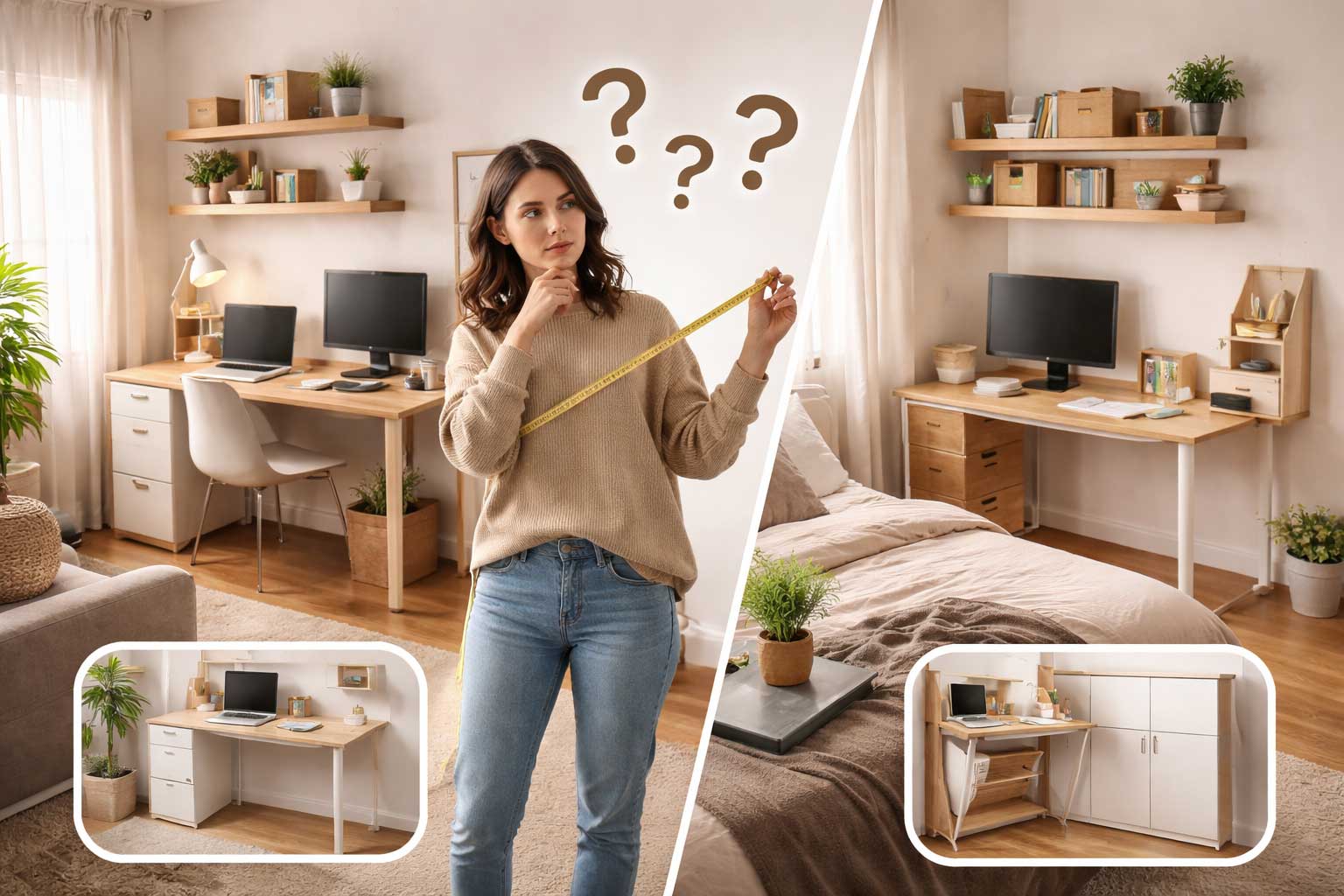
Shape can make a major difference in how natural a desk feels in a small apartment. Two desks with similar surface area may behave very differently depending on whether they are straight, narrow, corner-based, or foldable.
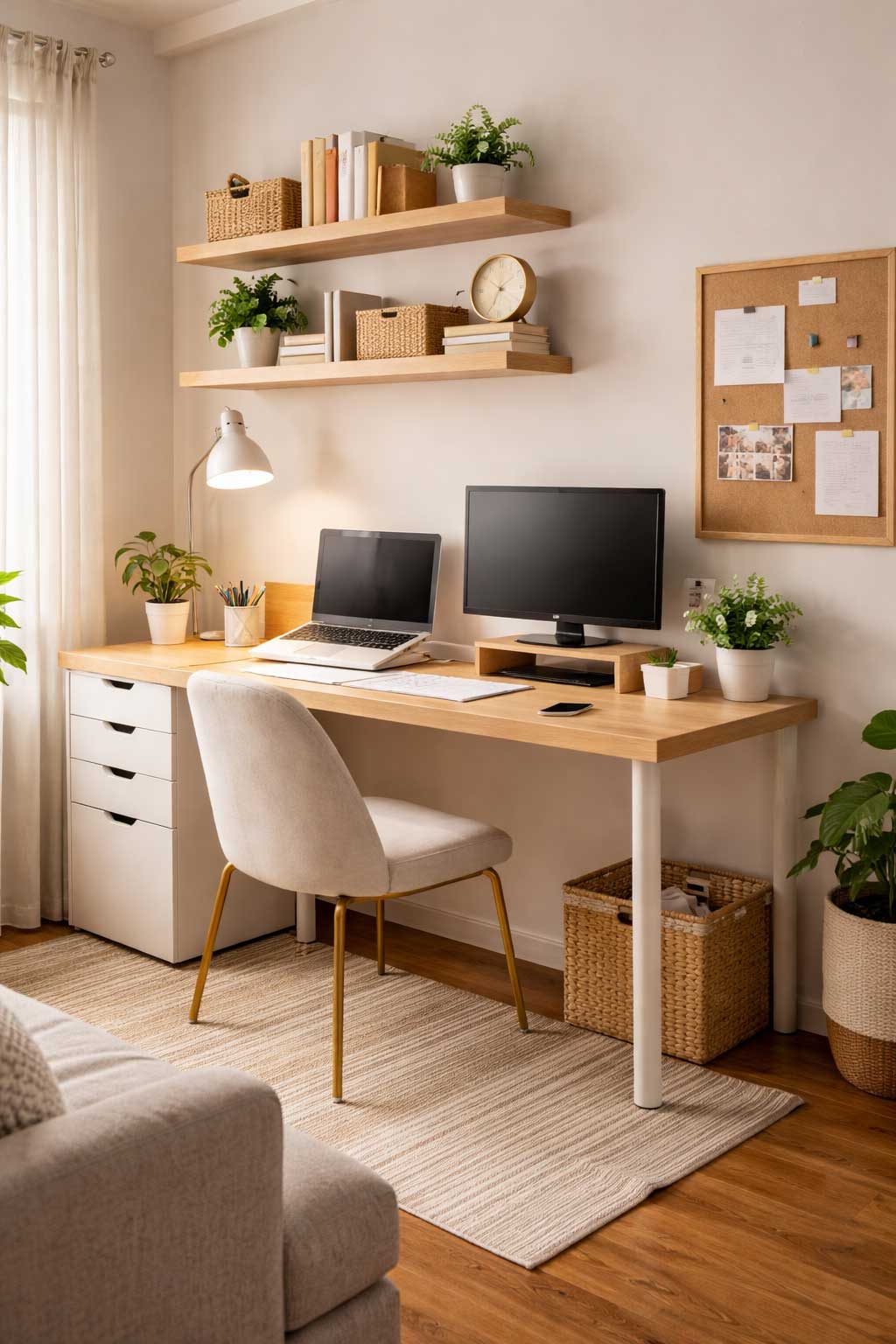
A standard rectangular desk is often the easiest choice because it is simple to place and tends to fit naturally against a wall. In many apartments, this is the cleanest option, especially when the desk needs to stay visually quiet. A narrow rectangular desk usually works especially well in bedrooms or along living room walls because it keeps the office zone compact without making the setup feel temporary.
Corner desks can be strong when the apartment has an underused angle that can support a defined work area. In the right layout, they can create a more anchored office zone and use space efficiently. In the wrong layout, they can feel bulky and harder to blend with the rest of the room. That is why Best Corner Desks for Small Apartments is a useful related page. Corner desks can be excellent solutions, but only when the room genuinely wants one.
Foldable desks make the most sense when the office setup is occasional, temporary, or living inside a room that cannot visually support a permanent office footprint all the time. They are often less about ideal ergonomics and more about flexibility. For the right apartment, that tradeoff can absolutely be worth it.
A small desk still needs to feel stable and usable
There is a difference between compact and flimsy. In a small apartment, a desk can and should be modest in scale, but it still needs to feel like a real working surface. If it wobbles, lacks enough depth for basic tasks, or forces everything into a cramped little strip of usable space, it may technically fit the apartment while still being the wrong choice.
This is especially true if you work from home regularly. A desk that looks tidy but never feels comfortable will wear on you quickly. If your laptop hangs too close to the edge, your monitor feels crowded, or your elbows are always short on space, the desk is undersized for your actual use. That kind of frustration often leads to more mess too, because items start spilling into nearby surfaces that were never meant to be part of the workstation.
The best desk in a small apartment is not the tiniest one available. It is the smallest desk that still lets you work comfortably. That distinction matters. A compact desk should simplify your space, not constantly remind you that you compromised too far.
This is where Best Minimalist Desk Setups for Small Apartments can support the conversation nicely. Minimalist should mean efficient and intentional, not cramped and underbuilt.
Built-in storage is helpful only when it solves the right problem
A lot of people assume that more built-in storage automatically means a better desk for a small apartment. Sometimes that is true. A desk with drawers or shelves can absolutely help keep supplies contained. But sometimes built-in storage makes the desk bulkier, heavier, and harder to fit into the room.
The real question is whether desk storage solves a need you actually have. If you mostly work digitally and only need a few tools nearby, a simple desk with a drawer or a small nearby organizer may be enough. If you use a lot of supplies daily, built-in storage may be more useful. But if the desk is carrying drawers you barely need, those extra components may just be adding visual and physical weight without improving the setup much.
In a small apartment, the smartest choice is often the one that separates function cleanly. Some people do better with a lighter desk and support storage nearby, such as a slim drawer unit, under-desk storage, or shelving above the workspace. Others benefit from an all-in-one desk that keeps everything contained. Neither approach is automatically better. The better one is the one that matches how you work without making the room feel heavier than it needs to.
This is part of why Best Under-Desk Storage Drawers for Small Offices and Best Floating Shelves for Small Apartment Offices can both be strong companion topics. They allow the desk itself to stay simpler if the room benefits from a cleaner footprint.
Visual weight matters as much as physical size
In a small apartment, how a desk looks in the room matters almost as much as how much space it takes up. A heavy desk with thick legs, dark bulky drawers, and a massive top can make a room feel more crowded even if the measurements are technically workable. A lighter desk with cleaner lines can often fit more gracefully into the exact same layout.
That is why visual weight is worth paying attention to. In a bedroom or living room especially, the desk is not just a tool. It becomes part of the room’s visual rhythm. If it looks too office-like, too industrial, or too heavy for the rest of the furniture, it may pull too much attention and make the space feel less relaxed.
This does not mean every desk has to disappear. It just means proportion matters. A desk that visually fits the room usually performs better in the long run because it does not constantly announce itself. In a small apartment, that kind of quiet fit is often more valuable than a piece that makes more of a statement.
This ties naturally into How to Choose Furniture for Small Apartments, because desks are one of the clearest examples of furniture that has to balance function with room feel. A desk can be good on paper and still wrong in the room if it feels too heavy.
Placement should be decided before the desk is purchased
A lot of desk mistakes happen because people buy first and place later. In a small apartment, that usually does not work well. The desk should be chosen for a specific location, not for a vague idea that it will somehow “fit somewhere.”
That means the placement decision needs to come first. Is the desk going in the bedroom, the living room, a hallway nook, or a corner near the dining area? Is it going against a straight wall? Does it need to sit near an outlet? Will it share space with a bed, sofa, or media console? Does the room need it to stay visually discreet? These questions matter because the same desk can work beautifully in one placement and feel completely wrong in another.
When the location is clear, desk shopping becomes much easier. You can measure the real wall, the real clearance, and the real path around it. You can also think about what the room needs visually. A bedroom corner might want a quieter, narrower desk. A living room wall might support a cleaner desk with minimal visible office clutter. A nook might be perfect for something slightly deeper or more built-in feeling.
Placement is half the decision. Without it, you are not really choosing the right desk. You are guessing.
A desk should help contain work, not spread it
One of the biggest advantages of choosing the right desk is that it helps work stay in one place. In a small apartment, that is incredibly important. If the desk does not support your routine well, work tends to spill outward. Papers land on the dining table. Chargers drift onto side tables. Bags and notebooks end up on the floor. The office starts extending itself into the rest of the apartment.
A well-chosen desk reduces that kind of spread. It gives your work a defined home. It does not have to hold every possible office item, but it should support the essentials well enough that you are not constantly borrowing space from nearby surfaces. That is a major part of what makes a desk “right” for a small apartment. It helps protect the rest of the home from becoming part of the office.
This is one reason desk choice and office organization are so tightly connected. If the desk is too small, too awkward, or too lacking in support, organization gets much harder. If the desk fits your needs and the room, it becomes much easier to keep the work zone contained and reset it at the end of the day.
That makes a real difference in how the whole apartment feels, especially if you work from home often.
The right desk should make the room easier to live in
At the end of the day, the best desk is not just the one that lets you work. It is the one that lets you work without making the room worse. It should feel proportionate to the apartment, useful for your routine, and clean enough in its footprint that the room can still feel like home after the workday is done.
That usually means choosing with more honesty than ambition. A smaller desk that fits beautifully is better than a larger one that technically squeezes in. A cleaner shape that keeps the room calm is often better than something bulkier with features you barely use. A desk that works naturally with the room is always better than one that makes the whole setup feel forced.