How to Choose Living Room Lighting for a Small Apartment
Living room lighting can completely change how a small apartment feels. The right setup makes the room feel warmer, more inviting, and easier to use at night. The wrong setup can make the space feel dim, flat, harsh, or smaller than it really is. In a compact apartment, that difference matters a lot because the living room often does far more than one job. It may be your TV room, reading space, hangout area, work-from-home overflow zone, and main relaxation space all at once.
That is why choosing living room lighting is not just about buying a lamp that looks nice. It is about building a setup that fits the way the room actually functions. A small living room usually needs enough light to feel open and practical, but it also needs softness. If the lighting is too harsh, the room feels exposed and uncomfortable. If it is too dim, it feels cramped and underfinished. The best setup usually lands somewhere in between, with enough flexibility to support both daily function and evening comfort.
One of the biggest mistakes people make is relying too heavily on a single overhead light. In most small apartments, that creates a room that is technically bright enough but still does not feel good. The living room ends up looking flat, with dark corners, glare around the TV, and not enough visual warmth near seating. The best lighting plans fix that by spreading light more intentionally through the room instead of blasting it from one point.
This topic fits naturally with How to Layer Lighting in a Small Apartment, How to Improve Lighting in a Small Apartment, and How to Make a Dark Apartment Brighter because living room lighting works best when it is part of a broader apartment lighting strategy. In a small home, every room matters, but the living room often matters most because it tends to be the space you live in after dark.
Why living room lighting matters so much in a small apartment
A small living room has less margin for error than a larger one. If the lighting is too harsh, the whole room feels uncomfortable very quickly. If it is too weak, the room starts to feel smaller and less finished. If one bulky fixture takes up too much visual space, it becomes more noticeable because the room itself is already compact.
This is also the room where atmosphere matters most. A kitchen can get away with being more purely functional. A bathroom can lean practical too. But the living room usually needs to feel comfortable. It is often the room where people spend the most time at night, which means the lighting has a big influence on how the apartment feels overall. If the living room lighting feels off, the whole apartment can feel less pleasant after sunset.
In many apartments, the living room is also visible from the kitchen, dining area, or entry. That means the lighting in this room affects the feel of more than just one zone. A warm, balanced lighting setup can make the whole apartment feel calmer and more intentional. A harsh overhead light can do the opposite.
This is one reason lighting is such a strong small-space upgrade. You do not need to knock down walls or buy all new furniture to improve how the room feels. Often, better lighting changes the mood faster than almost anything else.
Start with what your living room actually needs to do
Before choosing fixtures, it helps to be honest about how you use the room. Some people mainly use the living room for watching TV and relaxing. Others read there every night. Some need the space to handle occasional laptop work, hobbies, or entertaining. Some use the living room as a general-purpose room because the apartment does not have a separate office or dining room.
Those daily habits matter because they affect what kind of lighting makes sense. A room built mostly around TV viewing needs a different balance than one built around reading and conversation. A living room that doubles as a work zone may need stronger task support than one that is purely for winding down. If you host people often, the room may need a lighting setup that feels warm and balanced from several angles rather than bright from one direction.
The most successful lighting plans usually grow out of those real habits. Instead of starting with style alone, start with use. Ask what the room needs to support after dark. Then choose lighting that matches that reality. In a small apartment, every piece has to earn its place, and lighting is no exception.
One overhead light is usually not enough
A ceiling fixture can help with general brightness, but it rarely creates the kind of layered, comfortable living room most people actually want. On its own, overhead light tends to flatten the room. It makes everything equally visible, but it does not necessarily make anything feel better. Seating areas can feel stark, corners stay oddly empty, and the room often ends up looking more functional than welcoming.
That does not mean overhead lighting is useless. In many apartments, it still plays an important role. It just should not have to do everything. A small living room usually feels much better when the overhead light acts as a base layer rather than the entire lighting strategy. Once you add one or two other light sources at lower levels, the room starts feeling more balanced almost immediately.
This is why How to Layer Lighting in a Small Apartment is such an important companion to this topic. The living room is often where layered lighting is easiest to notice and easiest to appreciate. One fixture can help with overall brightness, while another supports reading or a soft evening glow, and another helps the room feel visually complete.
That layered approach matters even more in open-concept apartments, where the living room is not isolated from the rest of the home. Better lighting gives the space more shape and identity without requiring more furniture or more square footage.
Floor lamps are often the easiest upgrade
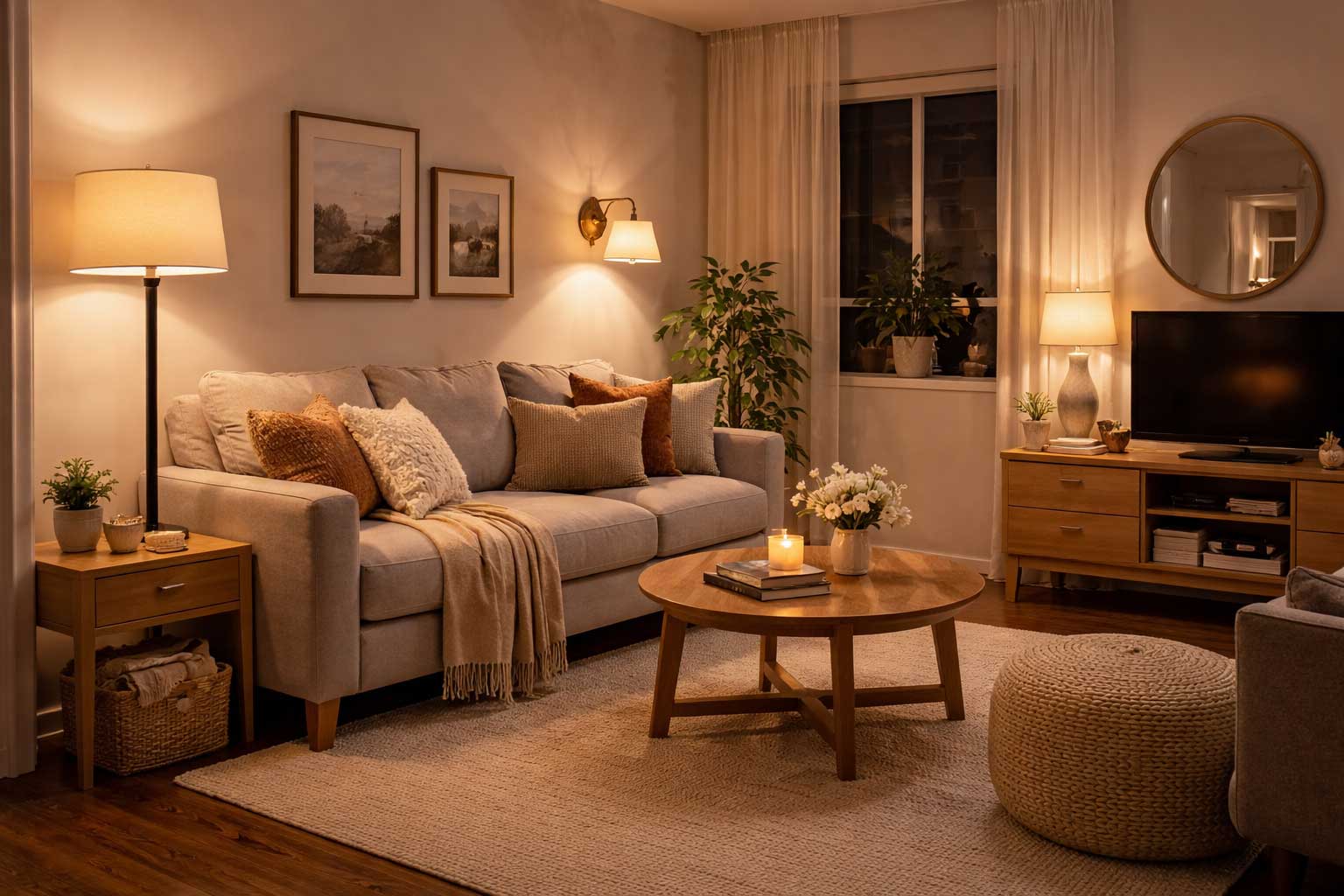
For many small apartments, a floor lamp is the simplest way to improve the living room quickly. It adds light at a lower level, helps soften the room, and usually does not require any major installation. A well-placed floor lamp can make the seating area feel more intentional and reduce the heavy dependence on the ceiling fixture.
Floor lamps work especially well beside sofas, next to accent chairs, or in corners that feel dark and underused. They help pull light outward across the room rather than concentrating everything overhead. That makes the room feel more layered and often a little larger too, because the eye notices more depth when the light comes from more than one height.
This is where Best Floor Lamps for Small Apartments can support the topic especially well. A floor lamp is often the most practical first purchase because it gives the room presence without needing a table surface. In apartments where space is especially tight, that matters. You get lighting support without necessarily sacrificing a nightstand, shelf, or tabletop.
The key is placement and scale. A floor lamp should support the seating zone or a dim corner, not awkwardly interrupt a walkway. In a small room, proportion matters. A sleek floor lamp that fits the room well will usually do more for the space than a huge dramatic one that makes the room feel crowded.
Table lamps help the room feel finished
If floor lamps often bring the first big improvement, table lamps are what usually make the room feel complete. A table lamp adds softness and intimacy in a way overhead lighting usually cannot. It helps create the kind of evening atmosphere people actually want in a living room, especially if the room is used for relaxing more than for bright activity.
Table lamps are especially useful on side tables, consoles, media-adjacent surfaces, or small shelving areas where the room feels visually empty at night. Even one carefully placed lamp can make a big difference. It gives the eye another point of warmth, which makes the room feel less flat and more designed.
That is why Best Table Lamps for Small Living Rooms is such a natural internal companion for this article. Table lamps are not always as powerful as floor lamps in terms of total output, but they often do more for mood. In a small apartment, that matters. The room does not just need light. It needs the right kind of light in the right place.
A table lamp can also help reduce the sense that everything in the room revolves around one bright ceiling source. Once light exists at sofa height or console height, the space feels more balanced and much easier to settle into at night.
Wall lighting can save space and add warmth
In some small living rooms, floor space and table space are both limited. That is where wall lighting becomes especially useful. Wall-mounted fixtures can add warmth and visual depth without taking up room on the floor or on furniture surfaces. In tighter layouts, that can be a major advantage.
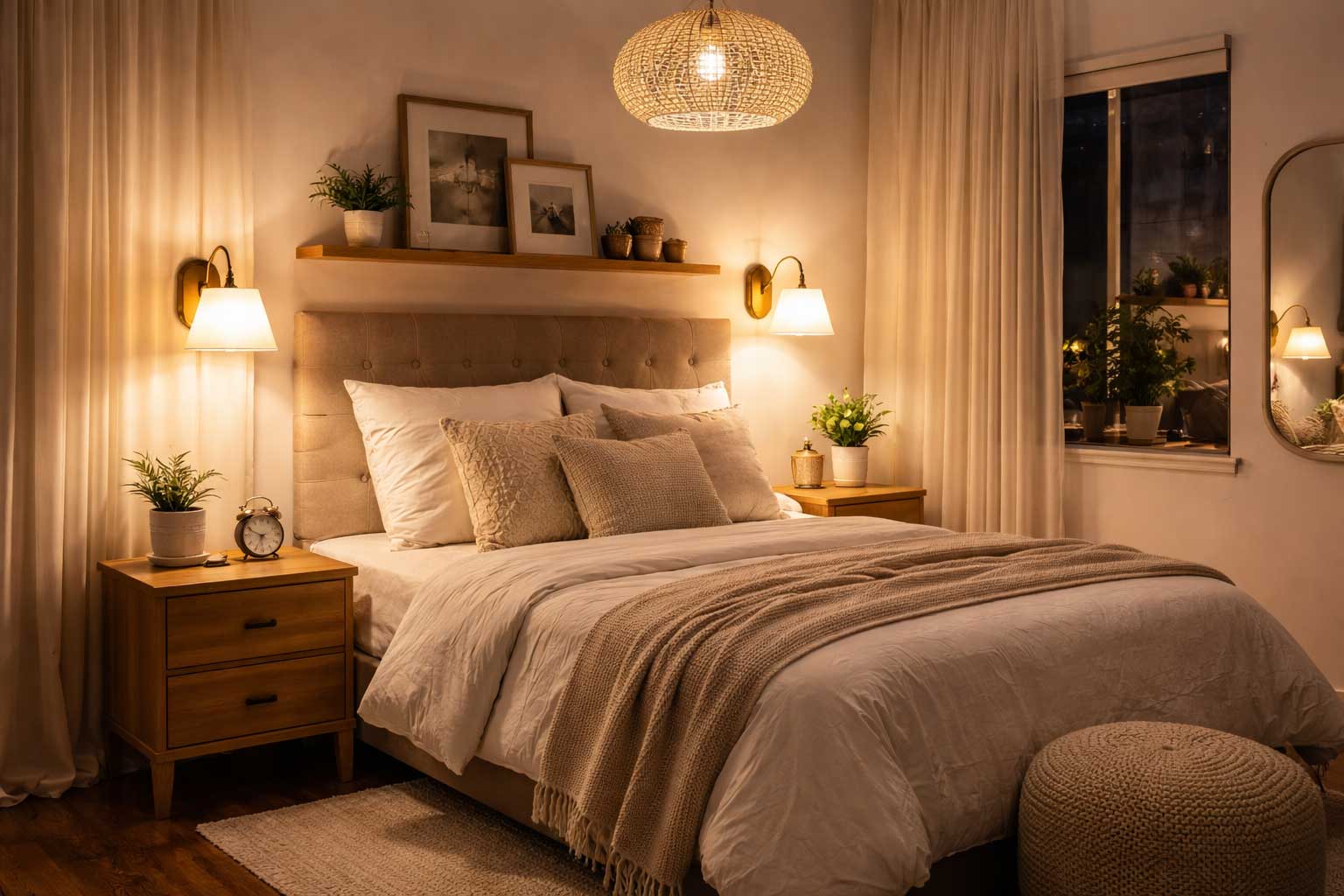
Wall sconces work particularly well when a room needs more softness near seating or when the living room shares space with another function and every surface is already doing something else. They also help spread light more evenly across the room, which can make the walls feel more active and the room feel less like one bright center surrounded by shadows.
This is one reason Best Wall Sconces for Small Living Rooms can be such a strong support page. Wall-mounted lighting is not always the first thing people think about in an apartment, but it can solve a lot of problems when the layout is compact. It gives the room another layer without asking much from the limited footprint.
In small spaces, wall lighting often feels more intentional than bulky. When used well, it adds character without clutter.
Corners should not disappear at night
One of the easiest ways for a small living room to feel smaller is for its corners to vanish once the sun goes down. When all the light comes from the ceiling or one central source, the edges of the room often become visually dead. That can make the entire room feel tighter and less inviting.
This is why corner lighting matters. A lamp in the right corner can make the room feel wider, warmer, and more complete. It does not have to be dramatic. It just has to help that part of the room participate in the overall lighting plan.
This is where Best Corner Floor Lamps for Small Living Rooms can support the subject especially well. In many apartments, corners are among the easiest places to add light without interrupting the main path through the room. A good corner light can also make the apartment feel less like it ends abruptly at night and more like it has depth.
That is especially valuable if your living room is narrow or shares space with a kitchen or entry area. Lighting a corner can make the whole layout feel more intentional without changing any furniture.
TV rooms need a different balance than non-TV rooms
If the living room centers around a television, lighting needs a little extra thought. A room that is great for reading at full brightness may not feel great for watching a movie. A strong overhead light can create glare and make the room feel less comfortable. On the other hand, a room that is too dark can feel cave-like and still not be ideal.
The best TV-friendly lighting setups usually rely less on the ceiling and more on lower, indirect light sources. Lamps beside seating, softer light in the corner, or light behind the general seating area tend to feel better than one strong source aimed broadly across the room. The goal is to keep enough ambient light in the room that it feels comfortable without creating sharp reflections or flattening the viewing area.
This is part of why living room lighting has to respond to real use instead of just looking good in daylight. If your evenings are built around the sofa and TV, the lighting should make that experience better, not harsher. A layered, lower-level approach often works better than maximum brightness.
Scale matters as much as brightness
A fixture can technically fit in the room and still be the wrong size for it. That is why scale matters so much in a small apartment. Oversized floor lamps, huge shades, or heavy bases can visually crowd a living room even before they physically get in the way. In a compact space, the lighting should support the furniture instead of competing with it.
This is especially noticeable in rooms that already have a sofa, coffee table, media unit, and maybe one or two side chairs. Once those pieces are in place, the lighting needs to work within the rhythm they create. Slimmer fixtures, cleaner silhouettes, and more proportional shapes often feel better than something large and dramatic that belongs in a room twice the size.
That does not mean the lighting has to disappear. It still needs enough presence to feel intentional. But in a small living room, proportion almost always matters more than visual drama. A well-scaled light will usually make the room feel more polished than a statement piece that takes too much attention and space.
This is one more reason lighting decisions tie so closely to layout. They are not separate from the furniture plan. They are part of it.
Placement should support the furniture arrangement
Living room lighting works best when it responds to the furniture rather than floating independently of it. A lamp beside the sofa makes sense because it supports the seating zone. A sconce near an accent chair makes sense because it reinforces a reading corner. A table lamp on a console can make sense because it adds light to a visually flat edge of the room.
That is why lighting often feels better after the furniture layout is already more settled. You can see where the room feels too dark, where a corner feels empty, or where the seating area needs more support. In a small apartment, that kind of responsiveness matters more than buying lighting first and hoping it finds a place later.
This overlap is part of why How to Arrange Furniture in a Small Apartment Living Room is such a useful internal link for the topic. Once the furniture arrangement is working, the lighting can reinforce it. When lighting and furniture support each other, the room feels much more intentional.
A small living room does not need random light scattered around it. It needs light that helps the room make sense.
Good living room lighting can make the whole apartment feel bigger
One of the biggest benefits of thoughtful lighting is that it changes perception. A small apartment living room often feels larger when light is distributed well. That happens because the room has more visible depth, more visual rhythm, and fewer areas that disappear into darkness. When the light reaches different parts of the room at different heights, the space usually feels more dimensional and less boxed in.
This is why lighting and spaciousness are so connected. A room may not gain a single inch, but it can still feel more open when it is lit in a more balanced way. That ties in naturally with How to Make a Small Apartment Feel Bigger, because lighting is one of the easiest ways to improve the feel of a room without changing the structure.
Small apartments benefit enormously from perception shifts. The layout may be fixed, but the feeling of the room is not. Better lighting helps the room feel more comfortable, which often reads as more spacious too.
The best living room lighting is flexible
In the end, the best lighting setup is usually the one that gives you options. A living room should not feel trapped in one mood all night. Sometimes you want more brightness. Sometimes you want a softer, lower-lit atmosphere. Sometimes you want light near the sofa but not in the rest of the room. Sometimes you want the whole space to feel more awake.
That is why layered lighting works so well. It gives the room flexibility without making the setup complicated. A small apartment living room does not need a huge number of fixtures. It just needs the right few pieces working together in a way that matches how the room is actually used.